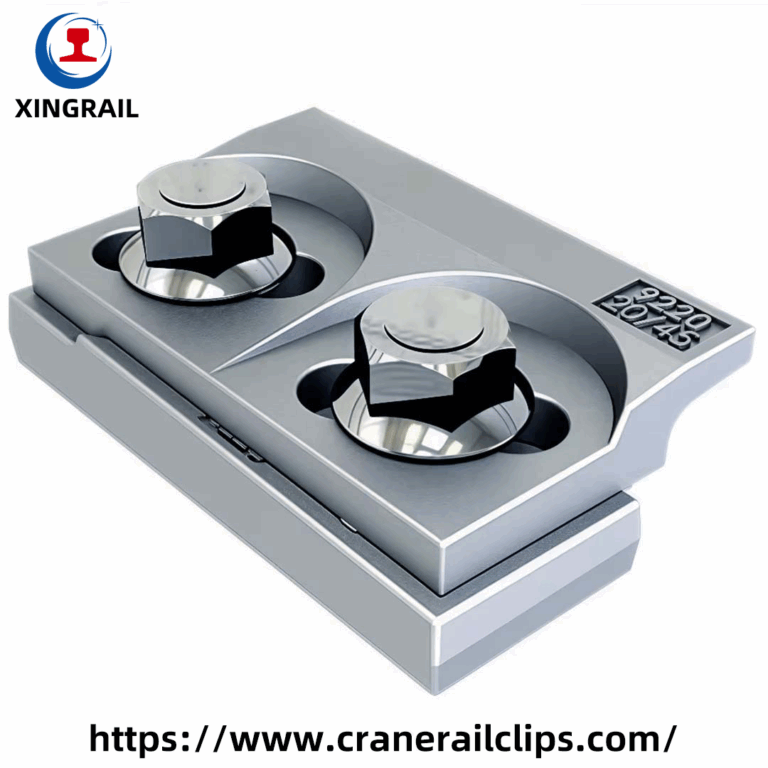
Crane rail clips are necessary for safe and effective crane operations in many industries. These clips stabilize and support the crane rail fastening system in industrial and heavy-duty settings. Bolted versus welded crane rail clips and rail clip selection tips require understanding their benefits. This blog will discuss crane rail clip kinds, selection factors, and maintenance and installation. Performance, safety, and smooth operations can be improved with the correct crane rail fixing solution.
Crane Rail Clip Operations Benefits
Crane rail clamps are necessary for safety and efficiency. Their inclusion in the crane rail fastening system stabilizes rails under severe loads. Heavy-duty clips for industrial applications and steel rail clips for lightweight cranes ensure a secure fit and reduce operational dangers. Welded crane rail clips hold better in dynamic situations, whereas bolted ones are more flexible. The correct crane rail fastening solution may make workplaces safer and meet safety standards.
They boost efficiency and versatility beyond safety. The crane rail installation guide and crane rail maintenance tips simplify installation and maintenance. This adaptability lets them work well in heavy-duty industrial environments and customized crane rail support clips. Businesses get best functionality adapted to their needs by considering rail clip choosing tips. Their versatility makes these clips ideal for diverse rail systems. They are necessary for safe and effective operations due to reduced downtime and constant performance.

Common Crane Rail Clip Uses
They are necessary in heavy-duty industrial activities that require stability and reliability. The fastening system relies on these clips to secure rails to their bases and work smoothly. Big robust clips avoid misalignment in manufacturing and steel processing operations. These situations also prefer welded crane rail clips for their firmer grasp. By choosing the proper crane rail repair solution, operators ensure constant performance and decreased downtime.
Ports and logistics facilities rely on crane rail clips for optimal operations. Support clips are necessary for handling containers and bulk commodities on varied terrains. Industrial adapt to varied crane sizes and operations. Operators can match steel rail clips for cranes or other customized components to their applications using rail clip selection suggestions. Crane rail maintenance guides help keep these systems in good shape and prevent unexpected failures. In busy, ports and logistics hubs may maintain safety and efficiency by using these clips.
Why Xingrail is the Industry Leader
Xingrail leads the crane rail clips industry with unique solutions for different operational needs. At Xingrail, we provide solutions that enhance safety, stability, and operational efficiency across diverse industries. We build our products with high-strength materials to handle demanding workloads while ensuring rail alignment and durability.
Whether you need bolted solutions for flexibility or welded options for permanent stability, we have you covered. With our expertise and tailored crane rail fastening systems, we help minimize risks, reduce downtime, and optimize performance. Trust Xingrail to keep your operations running smoothly and securely.
Deep-Dive Technical Notes
The Largest Gantry Crane and the Rail Clips That Hold It Down
Other Giants Worth Knowing
Taisun holds the capacity record, yet several other gantry cranes are famous in their own right. Samson and Goliath at the Harland & Wolff yard in Belfast are probably the most photographed. Goliath handles 840 tonnes, Samson 840 tonnes as well, and both have become city landmarks. The Kockums Crane in Malmö, rated 1,500 tonnes, was dismantled and shipped to Hyundai in Korea in 2002 — Swedes still call the day it left “the Tears of Malmö.” Korean and Chinese shipbuilders now run Goliath gantries in the 1,200 to 2,000 tonne class as standard equipment. And in the container world, the biggest ship-to-shore gantry cranes carry far less load per lift, maybe 65 to 120 tonnes under the spreader, but they move constantly and hammer their rails much harder over a working life. That distinction matters. A record-breaking lift happens once. A container crane makes thirty moves an hour, every hour, for twenty years.
Elastic Rail Clips Dimensions
Manufacturing Process:
Bar Heating: Workers cut the steel bars to the correct length and heat them to a precise temperature (around 950–1000°C) to make them malleable. Forging: Workers quickly transfer the hot bar to a press and forge it into its final shape through a series of high-pressure stamping operations. Quenching: The formed clip is immediately quenched in oil. This rapid cooling process creates a very hard and strong martensitic microstructure, which is the source of the steel’s spring properties. Tempering: After quenching, the clip is extremely brittle. Workers reheat it to a much lower temperature (around 400–500°C) in a process called tempering. This relieves internal stresses and gives the clip the required toughness and ductility, ensuring it will not fracture in service.
How to Choose the Best Rail Clip Manufacturer
4. Production and Quality Assurance
Another important area to look into is the manufacturing process itself. Reliable performance depends on consistent production quality. Inquire about their manufacturing processes. Ask them about their quality control procedure as well. Regular testing should be carried out by a manufacturer. Dimensional accuracy, material hardness, tensile strength, and fatigue life should all be tested. Third-party audits and factory tours can offer insightful information about their dedication to quality.
A Comprehensive Guide to Railroad Clip from Xingrail
2. Heating and Shearing
Steel bars are fed into shearing machines by production teams. The bars are precisely cut to length by the machine. The cut bars then go into the heating furnace. The temperature is quickly raised by induction heaters. The steel can reach temperatures between 950°C and 1000°C. The metal becomes malleable for forming at this temperature.