The railway sleeper, also known as a railroad tie, is the foundational transverse element of the track structure. Its primary role is to support the rails and transfer the immense loads from a passing train to the underlying ballast and subgrade. Beyond simple support, the railway sleeper is a highly engineered component responsible for maintaining the correct track gauge and providing a stable base for the entire fastening system. This technical guide explores the specifications, materials, and performance characteristics of the modern railway sleeper, covering the four principal types: wood, concrete, steel, and composite.

Core Functions and Performance Specifications
Regardless of the material it is made from, every railway sleeper must perform a set of critical functions to ensure the safety and integrity of the track.
- Gauge Retention: It holds the two rails at the correct distance apart (the track gauge).
- Load Transfer: It collects the vertical, lateral, and longitudinal forces from the rails and distributes them over a wider area of the ballast.
- Stability and Anchorage: It anchors the rail fastening system, providing resistance against rail movement, and its own mass and shape provide resistance to track shifting or buckling.
- Electrical Insulation: In track circuits used for signaling, the sleeper must help to electrically isolate the two rails from each other.
To perform these functions, sleepers are designed to meet demanding specifications for strength, durability, and dimensional accuracy.
Types of Railway Sleeper and Their Specifications
The choice of sleeper material has a profound impact on track performance, maintenance requirements, and overall lifecycle cost.
1. The Wooden Railway Sleeper
The traditional wooden sleeper has been used for over 150 years. Typically made from hardwoods like oak, they offer a unique combination of strength, elasticity, and ease of handling.
- Material Properties: Hardwood is chosen for its high compressive strength and natural resistance to decay. To enhance their lifespan, wooden sleepers are pressure-treated with preservatives like creosote. This process forces the preservative deep into the wood fibers, protecting them from moisture, fungi, and insects.
- Performance Characteristics: Wood has excellent vibration-damping properties, which contributes to a quieter track. Its elasticity allows it to absorb impacts without fracturing. However, wooden sleepers are susceptible to rot, splitting, and mechanical wear from the tie plate over time.
- Compatibility: Wooden sleepers are highly versatile and compatible with a wide range of rail profiles, from light 115RE sections to heavy 141RE sections. They are typically used with tie plates and secured with driven spikes or high-strength screw spikes.
|
Specification |
Typical Value (Hardwood Mainline Sleeper) |
Purpose |
|
Dimensions (L x W x H) |
2.6m x 225mm x 175mm (8′ 6″ x 9″ x 7″) |
Provides sufficient bearing area on the ballast and depth for spike retention. |
|
Material |
Creosote-treated Oak or other hardwoods |
Offers a balance of strength, elasticity, and decay resistance. |
|
Service Life |
20-40 years |
Depends on climate, traffic tonnage, and maintenance practices. |
2. The Concrete Railway Sleeper
The pre-stressed concrete sleeper is the standard for modern high-speed and heavy-haul railways. It offers exceptional strength, uniformity, and a very long service life.
- Material Properties: Concrete sleepers are made from high-strength concrete (typically over 60 MPa or 8,700 psi). They are “pre-stressed” during manufacturing, where high-tensile steel wires or strands running through the mold are tensioned before the concrete is poured. Once the concrete cures, the tension is released, placing the entire sleeper under permanent compression. This pre-compression makes the sleeper extremely resistant to the bending forces and cracking that would otherwise occur under train loads.
- Performance Characteristics: The high mass of a concrete sleeper provides excellent track stability, making it highly resistant to lateral shifting and essential for long welded rail (LWR) systems. They are impervious to rot and insects. Their primary disadvantage is a lack of elasticity, which can result in a stiffer, noisier track if not paired with an appropriate fastening system and resilient pads.
- Compatibility: Concrete sleepers are designed for use with elastic rail clips. A cast-iron shoulder is embedded directly into the concrete during manufacturing to hold the clip. They are produced to precise dimensions for specific rail profiles, such as 60E1 or 136RE, ensuring perfect gauge and rail seat cant.
|
Specification |
Typical Value (Mainline Concrete Sleeper) |
Purpose |
|
Dimensions (L x W x H) |
2.5m – 2.6m x 300mm (base) x 220mm (rail seat) |
Optimized shape provides a wide base for stability and a strong rail seat area. |
|
Weight |
280-320 kg (600-700 lbs) |
The high mass is critical for providing lateral track stability. |
|
Reinforcement |
Pre-stressed high-tensile steel wires |
Puts the concrete in compression, providing immense strength and crack resistance. |
|
Service Life |
50+ years |
Highly durable and resistant to environmental degradation. |
3. The Steel Railway Sleeper
Steel sleepers are a lightweight alternative to wood and concrete, often used in specific applications like secondary lines, desert environments, or on tracks with sharp curves.
- Material Properties: They are hot-rolled from steel and formed into a trough-like shape. This shape allows the ends to be packed with ballast, which provides excellent lateral resistance despite the sleeper’s low weight. They are typically galvanized or coated for corrosion protection.
- Performance Characteristics: Steel sleepers are lightweight, easy to handle and transport, and fully recyclable. They offer excellent gauge retention because the fastenings are often welded directly to the sleeper. However, they are susceptible to corrosion, particularly in wet or saline environments, and can be more prone to fatigue failure over time.
- Compatibility: Fastening systems are often welded to the sleeper, making them specific to a certain rail profile and clip type. Their use in track-circuited territory can be problematic as they are not natural insulators.
4. The Composite (Plastic) Railway Sleeper
Composite sleepers are a relatively new and emerging technology. They are manufactured from recycled materials, typically a mix of plastics and fiberglass.
- Material Properties: These sleepers are engineered to mimic the properties of wood. They can be drilled and spiked just like a wooden sleeper, making them a “drop-in” replacement. They are impervious to rot, water, and insects.
- Performance Characteristics: The primary advantage of composite sleepers is their extreme durability and resistance to environmental degradation. They have a very long expected service life and make use of recycled materials. Their main drawbacks are a higher initial cost and a lack of long-term performance data compared to wood and concrete. Their mechanical properties, such as stiffness and thermal expansion, can also vary between manufacturers.
- Compatibility: Designed to be a direct substitute for wood, they are compatible with standard tie plates and spike systems for virtually any rail profile. This makes them ideal for spot replacements within existing wooden sleeper track, especially in areas with high decay rates like level crossings and tunnels.
Related Crane Rail Clips Products
Based on the content from the provided link, here are the most relevant crane rail clips products, their series, and specific products with internal links. The specification table from the content is also included for detailed reference.
XINGRAIL Elastic Rail Clips Series
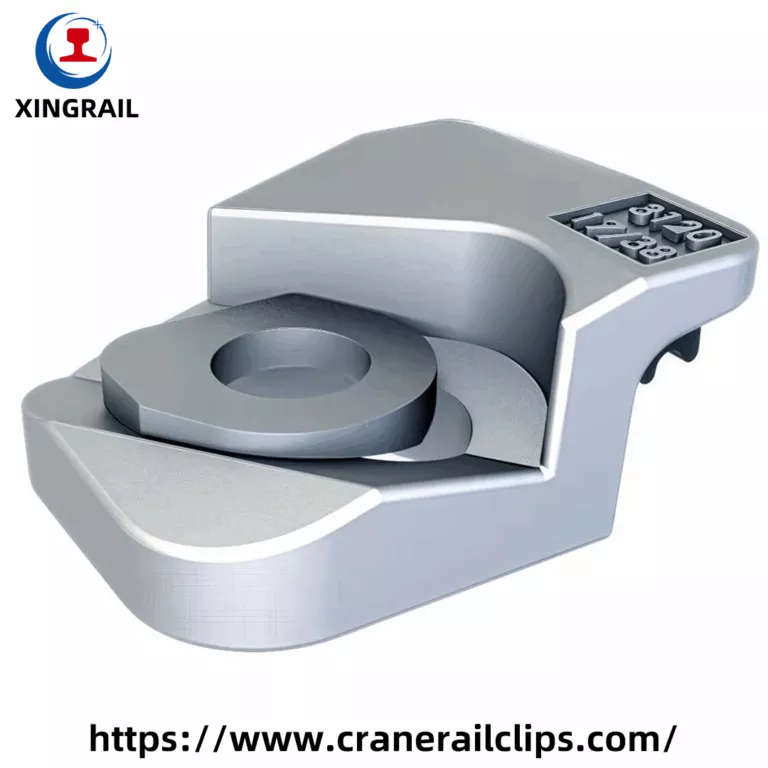
Elastic rail clips are essential for securing rails to sleepers, ensuring stability, and absorbing vibrations. These clips are compatible with various sleeper types, including wooden, concrete, steel, and composite sleepers, making them ideal for diverse railway construction projects.
Specification Table:
|
Clip Type |
Material |
Typical Toe Load |
Application |
Key Feature |
|
Pandrol e-Clip |
Spring Steel |
1,850 – 2,250 lbs (8.2 – 10.0 kN) |
Concrete & Wood Sleepers |
Threadless, easy installation |
|
Vossloh Sk Clip |
Spring Steel |
2,250 – 2,700 lbs (10.0 – 12.0 kN) |
Concrete & Wood Sleepers |
High creep resistance |
|
Pandrol Fastclip |
Spring Steel |
1,850 – 2,250 lbs (8.2 – 10.0 kN) |
Concrete Sleepers |
Pre-assembled for mechanized installation |
FAQs
- What are the primary applications of elastic rail clips?
Elastic rail clips are used to secure rails to sleepers, ensuring stability and reducing vibrations in railway tracks. They are compatible with wooden, concrete, steel, and composite sleepers. - How do elastic rail clips improve track performance?
Elastic rail clips provide a constant clamping force, allowing for controlled rail movement and vibration absorption, which reduces wear on track components. - What is the difference between Pandrol e-Clip and Vossloh Sk Clip?
The Pandrol e-Clip is threadless and easy to install, while the Vossloh Sk Clip offers higher creep resistance and is secured with a screw spike. - Are elastic rail clips suitable for high-speed railways?
Yes, elastic rail clips like the Vossloh Sk Clip and Pandrol Fastclip are designed for high-speed and heavy-haul railways, providing excellent stability and durability. - What materials are used to manufacture elastic rail clips?
Elastic rail clips are typically made from high-quality spring steel, which provides the necessary strength and elasticity to endure heavy loads and vibrations.