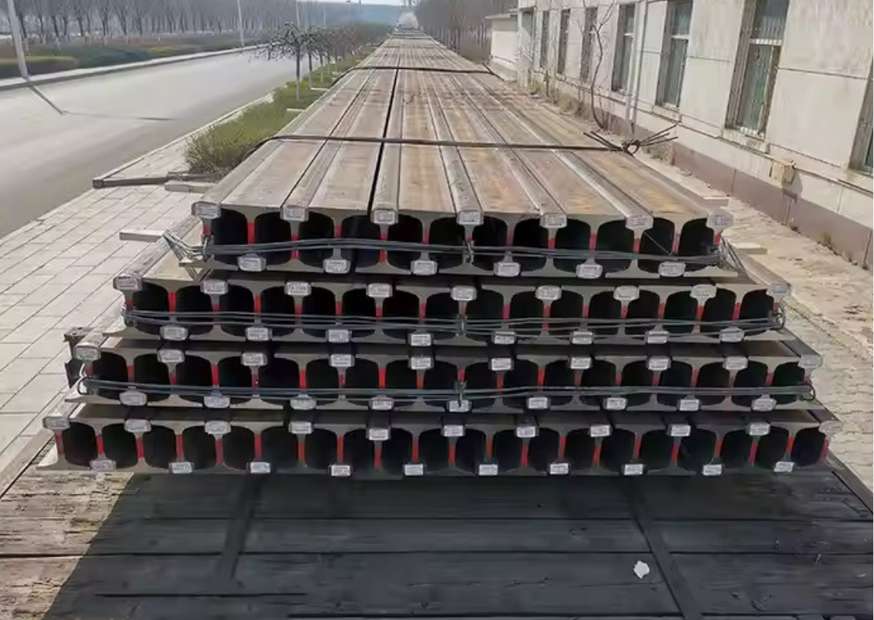
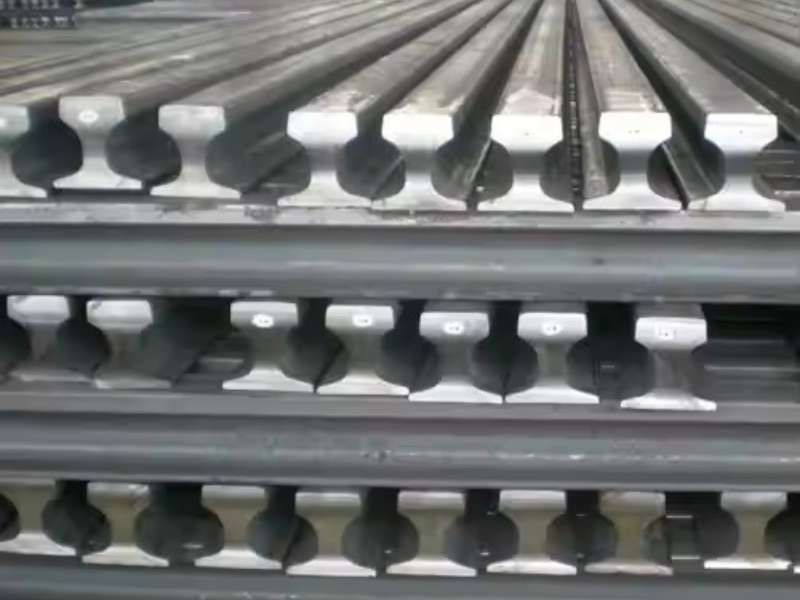
GB 3426 governs QU-series crane rails in China. The “80” in the designation refers to the rail head width in millimetres, not the weight per metre. QU80 measures 80 mm across the head, 130 mm at the base, 130 mm in height, and 32 mm at the web, weighing 63.69 kg/m (approximately 43 lb/yd). Typical applications include port container yards, steel-plant casting cranes, and workshop overhead bridge cranes.
For full dimensional data, see QU80 crane rail dimensions.
Why QU80 Rail Needs Its Own Clip
Rail clip selection is driven by rail profile, not rail series. QU80’s 130 mm base width and 32 mm web thickness set the jaw opening and clamping stroke. A QU70 clip (120 mm base) leaves the flange unsupported. A QU100 clip (150 mm base) cannot close onto the narrower flange. Either mismatch leads to flange damage, loss of anti-creep force, and eventual rail walk.
Standard railway elastic clips — Pandrol e-clip types — are designed for heavy-haul bases wider than 150 mm. They do not seat on a 130 mm base. Dedicated QU80 rail clips are sized specifically to this profile and should be the only option considered.
See the QU70–QU120 clamp series for the full pairing table. If you are unsure whether your rail is QU80 or the similarly named CR80, check CR80 rail dimensions — they follow different standards and have different profiles.
Welded vs Bolted QU80 Rail Clips
Two families of QU80 rail clips cover most installations.
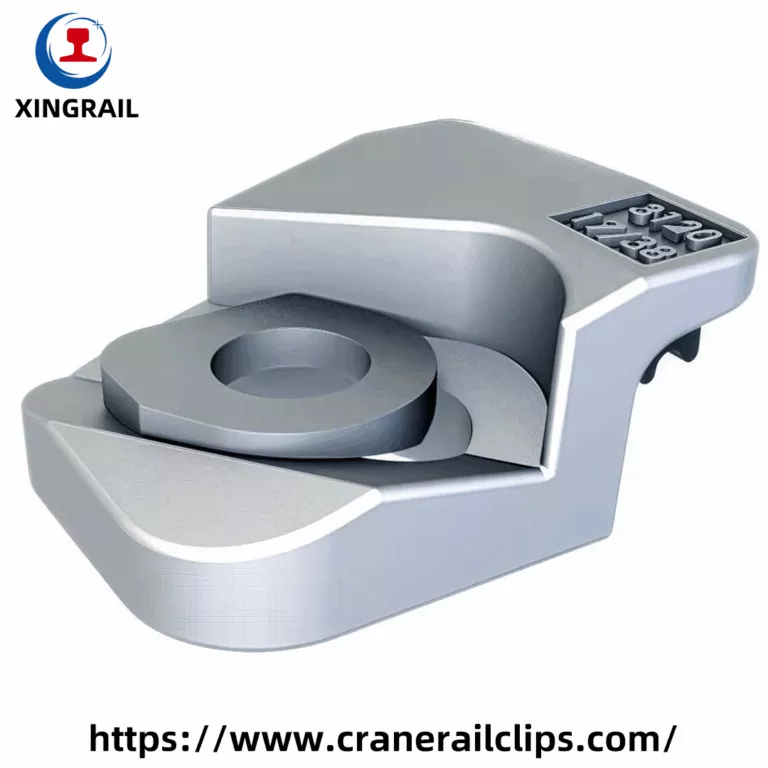
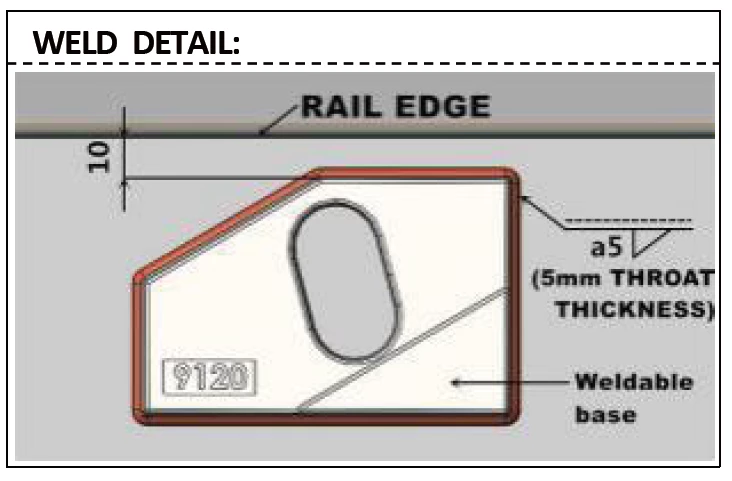
9 Series welded clips — the 9120/15/38 is the welded fastener specified for QU80 (130 × 130, 63.69 kg/m). It comes with insulating pad (S variant) or without pad (H variant). Welded clips suit high-vibration, continuous-duty cranes such as RMG gantries in port container yards. See the 9 Series welded clamp for torque values and jaw clearance data.
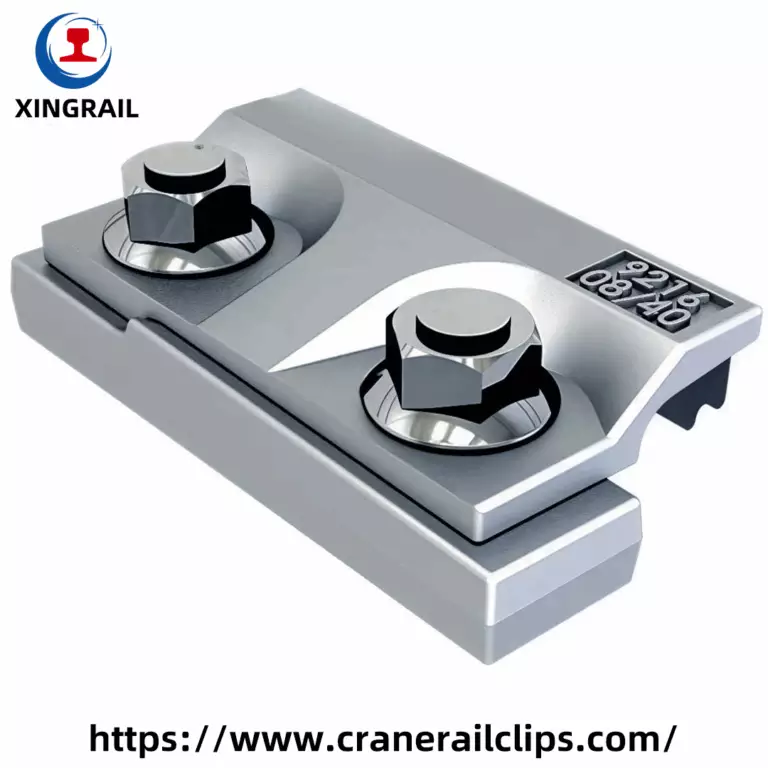
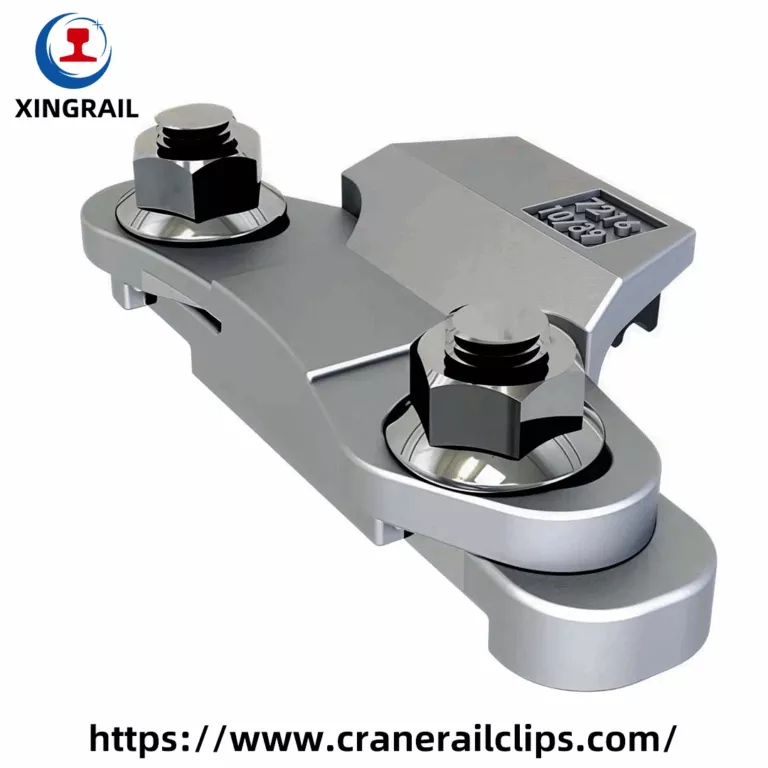
Bolted self-locking clips (3120 / 3220 / 3222) — these flexible clamp plates cover the QU70–QU120 family (base widths 120–170 mm). They allow on-site shimming and alignment adjustment, making them well suited to new-build runways where final rail position is still being confirmed.
Decision rule: choose bolted clips for new construction and fine-positioning work; choose welded clips for high-cycle gantries where eliminating re-torque intervals matters.
Sizing, Pads, and Installation Checks
Before ordering, confirm the following:
- Rail base width tolerance (nominal 130 mm as-rolled)
- Insulating pad requirement — RMG and harbour cranes with electrical positioning systems typically need pads
- Bolt grade and target clamping force from the product data sheet
- Clip spacing along the full runway length
- Re-torque schedule after the first load cycles
Follow the crane rail fastening system installation guide for spacing intervals and torque sequences.
QU-Series and Related Rail Comparison
| Rail profile | Base width | Section weight | Fastener family |
|---|---|---|---|
| QU70 | 120 mm | — | QU70-profile clip |
| QU80 | 130 mm | 63.69 kg/m (43 lb/yd) | 9 Series welded 9120/15/38 or bolted 3120/3220/3222 |
| QU100 | 150 mm | — | QU100-profile clip |
Use the rail clip selector to confirm the match for your specific rail and beam combination.

QU80 Clips by Crane Application
- Port / RMG container yards — welded 9120/15/38 with insulating pad; high-cycle continuous duty
- Steel-plant casting cranes — welded clips, pad only if electrical isolation is required
- Warehouse stacker runways — bolted 3120 with shimming for levelling during commissioning
- Workshop overhead cranes — welded or bolted depending on cycle count and vibration level
Every application calls for the same three decisions: profile match, clip family, and pad specification.
Sourcing QU80 Rail Clips
When requesting a quote, give your supplier the following information:
- Rail profile drawing or confirmed base width (130 mm)
- Insulating pad requirement
- Required bolt grade
- Surface finish — hot-dip galvanised is standard for port environments
- Clip spacing interval and total runway length
Specifying profile-matched QU80 rail clips from the outset avoids the cost of replacing mismatched fasteners after the runway is built.
Frequently Asked Questions
Q1: Does a QU80 rail need a special clip?
Yes. The 130 mm base width determines jaw opening. General-purpose railway elastic clips are sized for wider heavy-haul bases and will not seat correctly on QU80’s flange edge.
Q2: Can I use a QU70 or QU100 clip on QU80 rail?
No. QU70 has a 120 mm base and QU100 has a 150 mm base. Neither jaw opening matches QU80. Refer to the comparison table above for the correct clip family.
Q3: Should I choose welded or bolted clips for QU80?
Choose welded 9 Series (9120/15/38) for high-vibration, continuous-duty cranes. Choose bolted 3120/3220/3222 for new-build runways where alignment adjustment is still needed during commissioning.
Q4: Is QU80 the same as CR80 or 80 lb/yd rail?
No. QU80 follows GB 3426 with a 130 mm base. CR80 follows a different Chinese standard with a distinct profile. See CR80 rail dimensions for a direct comparison.
Q5: How do I know which clip series fits my QU80 rail?
Start with the 130 mm base width to identify the correct family, then use the rail clip selector to confirm the exact model against your beam width and spacing requirements.