This technical guide provides a detailed breakdown of crane rail dimensions and ASCE rail dimension, focusing on the specific profiles, material properties, and fastening systems associated with each. While both are used in specialized applications, their design principles differ significantly. Crane rails are engineered with a thick web and wide head to handle extreme wheel loads from overhead cranes, while ASCE rails offer a standardized profile for light-duty industrial tracks, temporary lines, and specific crane applications where loads are less severe.
Crane Rail Dimensions and Profiles
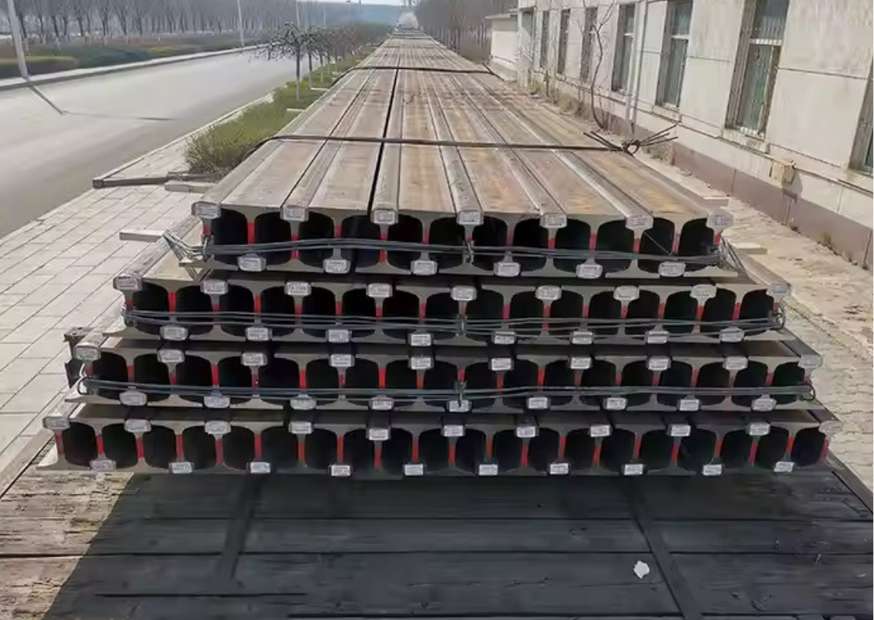
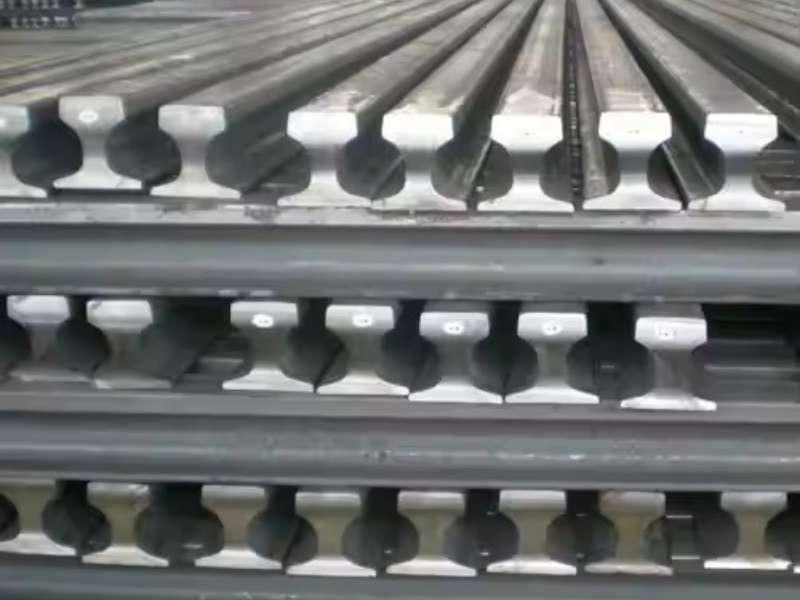
The crane rails are specialty profiles designed to withstand the immense, concentrated, and repetitive loads imposed by gantry cranes, overhead cranes, and port container handling equipment. The key feature of all crane rail dimensions is a very thick web and a wide, low-profile head. This robust cross-section distributes the wheel load over a larger area of the rail foot and support structure, minimizing stress and deformation. Crane rails are typically defined by their weight in kilograms per meter (e.g., A45, A120) or pounds per yard (e.g., CR175).
Common Crane Rail Profiles (A-Series)
The “A” series is a European standard (DIN 536) that has been adopted globally for crane applications. The number in the designation, such as A75 or A100, indicates the approximate width of the rail head in millimeters. The distinct crane rail dimensions of this series provide exceptional strength and stability.
|
Profile |
Mass (kg/m) |
Height (mm) |
Head Width (mm) |
Base Width (mm) |
Web Thickness (mm) |
|
A45 |
22.10 |
55 |
45 |
125 |
25 |
|
A55 |
31.80 |
65 |
55 |
150 |
31 |
|
A65 |
43.10 |
75 |
65 |
175 |
38 |
|
A75 |
56.90 |
85 |
75 |
200 |
45 |
|
A100 |
74.30 |
95 |
100 |
200 |
50 |
|
A120 |
100.00 |
105 |
120 |
220 |
60 |
|
A150 |
150.30 |
150 |
150 |
220 |
80 |
Steel Grades and Material Properties
Crane rails are manufactured from high-carbon steels to achieve the necessary hardness and wear resistance. Unlike railway rails, which prioritize fatigue resistance over long distances, crane rail steel must have high yield strength to prevent localized plastic deformation under extreme wheel pressures.
- Standard Grades: Typically have a tensile strength of 690-880 MPa. These are suitable for light to medium-duty crane runways.
- High-Strength Grades: Offer tensile strengths of 880 MPa and above. These are specified for high-capacity, high-frequency crane operations, such as those found in steel mills and major container ports. The material is designed to have a hardness that resists crushing and spalling.
Crane Rail Clips and Fastening Systems
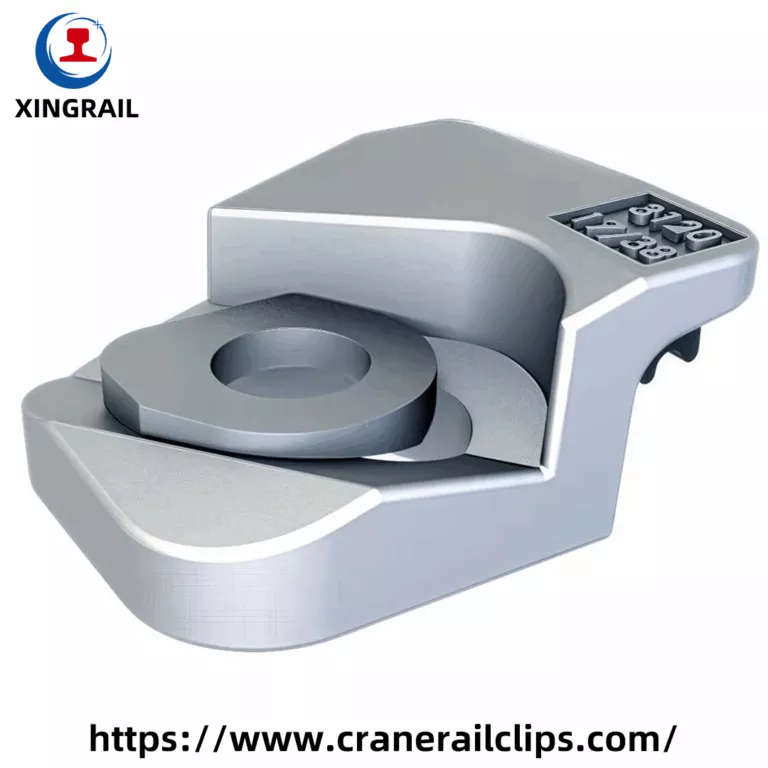
Fastening systems for crane rails are fundamentally different from those used in traditional railways. Their primary goals are to allow for precise rail alignment, absorb lateral forces from crane wheels, and permit controlled longitudinal movement of the rail due to thermal expansion. Two main types of clips are used: bolted clips and welded clips.
Bolted Crane Rail Clips
Bolted clips are the most common type. They consist of an upper component that presses down on the rail foot and a lower component that is bolted to the steel girder or concrete foundation.
- Functionality: They use a combination of mechanical clamping and an elastomeric “nose” that presses against the rail web. This elastomer allows for minor lateral movement and absorbs shock, reducing wear on both the rail and the support structure.
- Key Features:
- High Clamping Force: Provides vertical restraint to keep the rail seated.
- Lateral Adjustability: Allows for precise alignment of the crane rail during installation and maintenance.
- Controlled Movement: The elastomeric component allows the rail to expand and contract longitudinally without building up dangerous internal stresses.
Welded Crane Rail Clips
Welded clips are used where a very strong, permanent connection is required. The lower part of the clip assembly is welded directly to the steel support girder.
- Functionality: An upper clip component is then bolted to the welded base, clamping the rail foot. This method provides superior lateral restraint and is often used for the highest-capacity cranes.
- Key Features:
- Maximum Lateral Restraint: The welded base provides immense resistance to side thrust from crane wheels.
- Durability: Eliminates the risk of anchor bolts loosening over time.
- Flexibility: Like bolted clips, they incorporate an elastomeric nose to allow for controlled rail movement and absorb impact.
|
Clip Type |
Primary Application |
Installation Method |
Lateral Restraint |
|
Bolted |
General overhead and gantry cranes |
Bolted to girder |
High |
|
Welded |
Very high-capacity, high-frequency cranes |
Welded to girder |
Extremely High |
Analyzing ASCE Rail Dimensions and Profiles
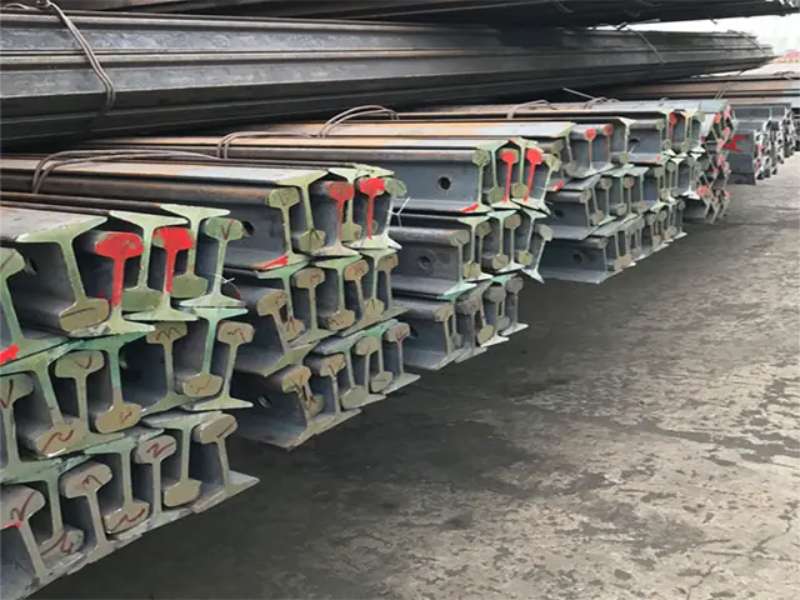
ASCE rail dimensions refer to a family of rail profiles standardized by the American Society of Civil Engineers. These rails have a classic “T” shape, similar to railway rails, but are typically lighter and used for less demanding applications. They are designated by their weight in pounds per yard (e.g., ASCE 25, ASCE 60). ASCE rails are common in light industrial tracks, mines, temporary construction railways, and some lighter-duty crane runways where wheel loads do not warrant a true crane rail profile.
Common ASCE Rail Dimensions and Specifications
The profiles are designed to be a cost-effective solution for applications where the extreme strength of a heavy railway or crane rail is not necessary. The ASCE rail dimensions provide a balance of strength and economy.
|
Profile |
Mass (lb/yd) |
Height (in) |
Head Width (in) |
Base Width (in) |
Web Thickness (in) |
|
ASCE 25 |
25 |
2.875 |
1.313 |
2.625 |
0.281 |
|
ASCE 30 |
30 |
3.125 |
1.500 |
3.000 |
0.313 |
|
ASCE 40 |
40 |
3.500 |
1.750 |
3.500 |
0.359 |
|
ASCE 60 |
60 |
4.250 |
2.250 |
4.250 |
0.438 |
|
ASCE 80 |
80 |
5.000 |
2.500 |
5.000 |
0.516 |
|
ASCE 85 |
85 |
5.188 |
2.563 |
5.188 |
0.563 |
Material Properties for ASCE Rails
ASCE rails are typically produced from standard-strength carbon steel, with properties suitable for their intended use.
- Tensile Strength: Usually in the range of 620-760 MPa.
- Hardness: Sufficient to resist wear from light-duty wheels but not intended for the extreme point loads seen in heavy crane operations.
Fastening Systems and Clips for ASCE Rails
Fastening systems for ASCE rails are more traditional and reflect their use in track-like applications.
Hook Bolts and Plate Clips
A very common method for securing ASCE rails to steel beams or concrete involves hook bolts.
- Functionality: A J-shaped bolt hooks under the support flange, and its threaded end passes through a steel clip that presses down on the rail foot. Tightening a nut on the bolt provides the clamping force.
- Application: This is a simple, cost-effective method suitable for light-duty crane runways and industrial tracks where precise alignment is less critical.
Rail Spikes
For ASCE rails laid on timber ties, traditional rail spikes are used.
- Functionality: Spikes are driven into the wood on either side of the rail foot, holding the rail in place through mechanical wedging. Tie plates are almost always used underneath the rail to distribute the load and prevent the rail from cutting into the timber.
- Application: This method is used for temporary tracks, mine railways, and light industrial sidings. It is not suitable for most overhead crane applications.
Bolted Rail Clips
For heavier ASCE rail installations on concrete, more robust bolted clips can be used. These are similar in principle to light-duty crane rail clips.
- Functionality: A clip is placed over the rail foot and bolted directly into an anchor that is pre-set in the concrete.
- Application: This provides better clamping force and alignment than spikes or simple hook bolts and is used for heavier industrial tracks and runways using ASCE 80 or ASCE 85 rail.
Recommended Products for Crane and ASCE Rail Dimensions
Engineering a safe and reliable industrial track requires matching your specific crane rail dimensions with the proper fastening system. The physical shape of the rail determines how it handles immense loads. Crane rails feature a thick web and wide head to manage extreme wheel pressure, while ASCE rails offer a lighter profile for standard industrial applications.
When selecting your fastening system, you must focus on the rail’s base width. Your chosen rail clip must sit perfectly flush against the bottom flange to apply the maximum downward clamping force. A precise fit ensures the clip locks the rail tightly to the supporting girder or concrete foundation. This tight grip neutralizes the intense lateral thrust from overhead cranes and prevents dangerous track misalignment.
To help you secure your heavy-duty runways and industrial sidings, we have paired our premium crane rail clips with common DIN 536 and ASCE rail profiles. Review the table below to find the exact fastening solution for your rail dimensions.
|
Rail Type |
Base Width |
Height |
Weight |
Recommended Clips |
|
ASCE 80 |
5.000 in (127.0 mm) |
5.000 in |
80 lb/yd |
32 Series Bolted Rail Clips |
|
DIN 536 A45 |
125.0 mm |
55.0 mm |
22.10 kg/m |
32 Series Bolted Rail Clips |
|
DIN 536 A75 |
200.0 mm |
85.0 mm |
56.90 kg/m |
9 Series Welded Rail Clips |
|
DIN 536 A100 |
200.0 mm |
95.0 mm |
74.30 kg/m |
9 Series Welded Rail Clips |
Frequently Asked Questions (FAQs)
- Why do heavy crane rails like the A100 require 9 Series Welded Clips?
Facilities use the A100 crane rail for massive gantry and overhead cranes that handle extreme payloads. These high-capacity operations generate severe lateral side-thrust against the rails. You weld the base of the 9 Series clips directly to the steel support girder, creating a permanent, unyielding anchor. This rigid structure securely grips the wide 200 mm rail base and safely resists extreme lateral forces. - Are 32 Series Bolted Clips suitable for lighter ASCE rail dimensions?
Yes. Track engineers frequently use ASCE rails, like the ASCE 80, for light industrial tracks and temporary runways. The ASCE 80 rail has a base width of 5 inches (127 mm). The 32 Series Bolted Clips match this narrower footprint flawlessly. They deliver strong downward clamping force while allowing maintenance teams to easily adjust the bolts for precise track alignment. - How does the base width of a crane rail dictate my choice of rail clip?
The base width is the most important measurement for fastening. Your rail clip only functions if it hugs the rail foot perfectly. If you install a clip designed for a 125 mm base onto a heavy rail with a 200 mm base, the fastener cannot seat flush. Without a flush fit, the clip cannot apply the necessary downward pressure, allowing the rail to shift under load. - How do 9 Series welded clips absorb the impact from heavy crane wheels?
While the lower base of the 9 Series clip welds rigidly to the steel girder, the upper fastening component features an advanced elastomeric nose. As heavy crane wheels roll over the thick rail head, this rubber-like component presses against the rail web. It flexes slightly to absorb shock and vibration, which protects both the rail and the support structure from premature wear. - What happens if I use the wrong clip on a heavy-duty crane rail profile?
Installing a mismatched clip on a robust profile like the A75 or A100 instantly compromises your crane runway. The clip will fail to grip the wide flange securely, resulting in a total loss of clamping force. The massive weight and movement of the crane will quickly push the unsecured rails out of gauge, leading to severe wheel wear, structural damage, and high derailment risks.