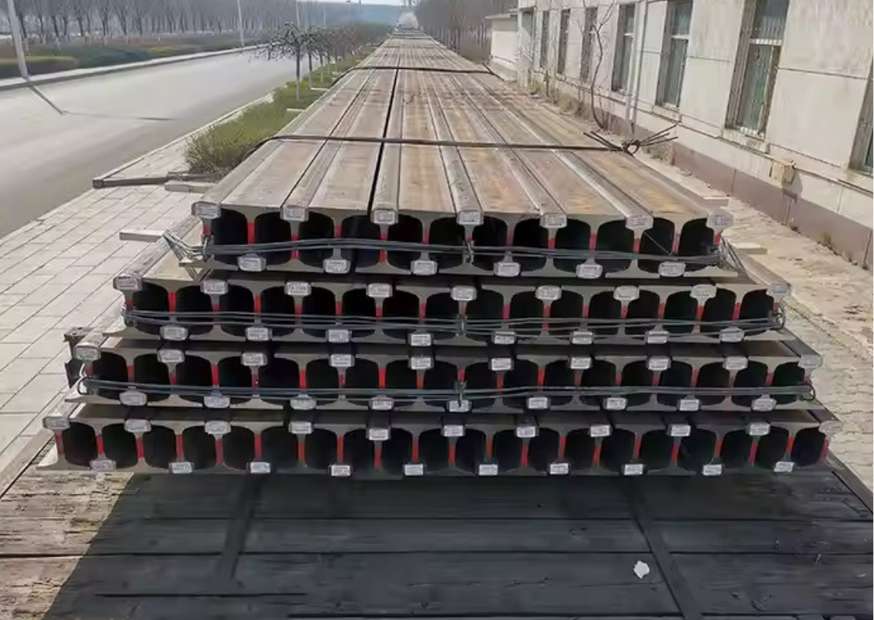
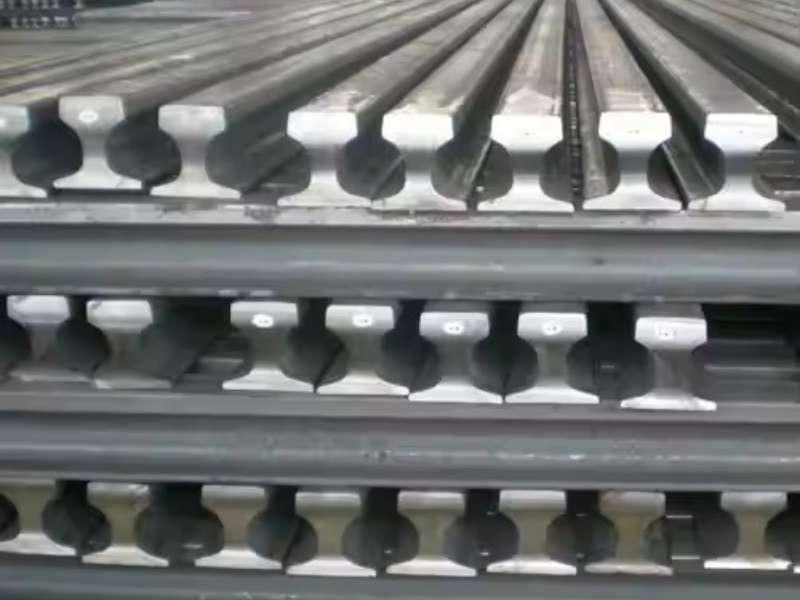
Railway track clamps are a broad category of engineered components designed to secure rails to a support structure, providing the stability and resilience required for safe train operations. These devices are more than simple fasteners; they are integral parts of a sophisticated system that manages immense forces, absorbs vibrations, and maintains precise track geometry. This technical guide Xingrail explores the specifications, dimensions, and material properties of various railway track clamps, from the elastic clips used on mainline railways to the robust clamps designed for heavy-duty crane runways.
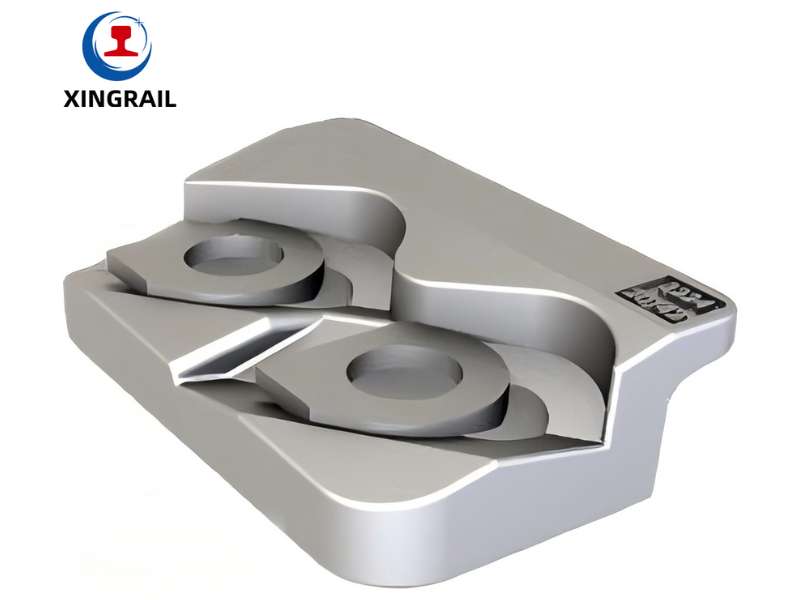
Elastic Railway Track Clamps (Rail Clips)
For most railway applications, the term railway track clamps refers to elastic rail clips. These components are essentially high-strength springs that apply a continuous, dynamic clamping force onto the foot of the rail. This elasticity is crucial for modern tracks, as it helps absorb vibrations from passing trains and allows for the controlled expansion and contraction of continuous welded rail without building up excessive stress.
Key Performance Specifications
The effectiveness of an elastic rail clip is defined by several key metrics, which are a direct result of its specific dimensions and material science.
- Clamping Force: This is the total downward force the fastening assembly exerts on the rail foot. This force is critical for generating the friction needed to resist longitudinal rail movement, also known as “rail creep.”
- Toe Load: This refers to the specific force applied at the very tip (toe) of the clip. It is a primary design metric, and a clip’s strength is often defined by its nominal toe load, measured in kilograms-force (kgf) or kilonewtons (kN).
- Fatigue Life: Rail clips must endure millions of load cycles from passing trains without breaking or losing their clamping force. A typical design specification requires a fatigue life of 3 to 5 million cycles.
Common Types and Dimensions
The most significant dimension that dictates a clip’s strength is the diameter of the spring steel bar from which it is manufactured.
|
Bar Diameter (mm) |
Typical Toe Load (kgf) |
Primary Application |
|
12-14 mm |
400 – 650 |
Light Rail Transit (LRT), Metro, Industrial Track |
|
16-18 mm |
750 – 1200 |
Mainline Passenger, Mixed-Traffic Routes |
|
18-20+ mm |
1200 – 2500+ |
Heavy-Haul Freight, High-Speed Lines |
- E-Type Clips: This globally recognized design (e.g., Pandrol e-Clip) is known for its simple, robust “e” shape. It is installed by being driven into a cast-iron shoulder that is embedded in a concrete sleeper. Heavy-duty versions, such as the e-2000 series, use a 20 mm bar to achieve toe loads exceeding 1800 kgf, making them an excellent choice for heavy-haul freight lines.
- SKL Tension Clamps: This screw-based system (e.g., Vossloh SKL-14) uses a screw spike to tighten the tension clamp against the rail foot. It offers excellent adjustability, making it a preferred solution for high-speed lines where maintaining precise track geometry is paramount.
Specialized Railway Track Clamps for Crane Rails
The railway track clamps used for crane runways are fundamentally different from those used on conventional railways. Crane rails are subjected to extremely high, concentrated wheel loads and significant lateral forces from wheel flanges. Crane clamps must secure the rail with immense strength while permitting precise alignment and allowing for controlled thermal movement. These are typically categorized as either bolted or welded clamps.
Bolted Crane Rail Clamps
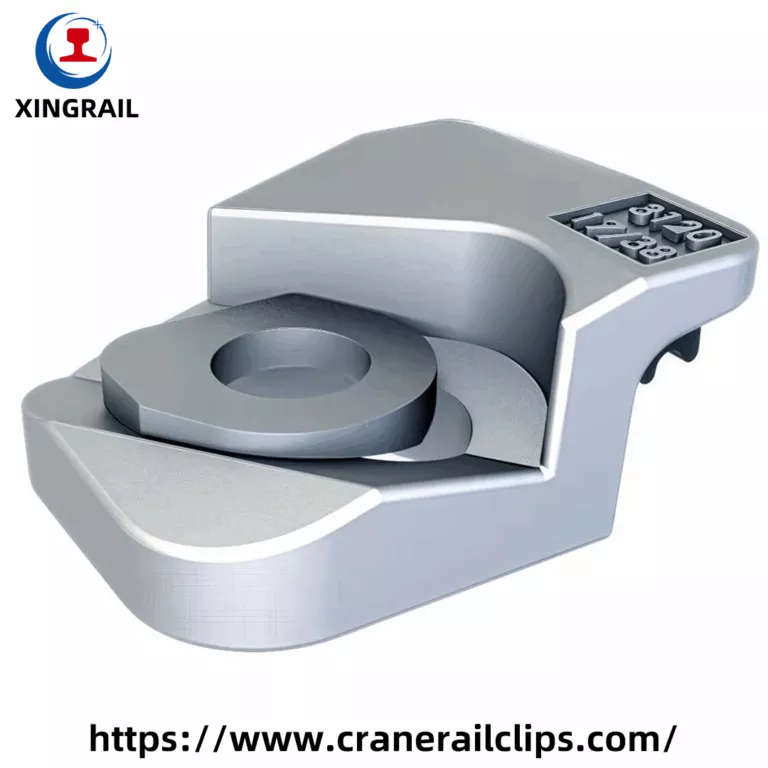
Bolted clamps are a versatile and widely used solution in crane runway systems. The assembly consists of a lower component that is anchored to the steel or concrete support structure and an upper component that clamps down onto the foot of the rail.
- Design and Functionality: A key feature of modern bolted clamps is an elastomeric “nose.” This is a durable rubber block integrated into the upper clamp component that presses firmly against the side of the rail’s web. This design absorbs shock and vibration while allowing the rail to “float” slightly. This is critical for accommodating thermal expansion and preventing the buildup of dangerous internal stresses that could warp the runway.
- Primary Advantage: The main benefit of bolted clamps is their adjustability. The bolt holes in the support structure are often slotted, which allows installers to make fine adjustments to the rail’s position, ensuring it is perfectly straight and set to the correct gauge before applying the final torque.
Welded Crane Rail Clamps
For the most demanding applications, such as high-capacity container cranes in ports or heavy-duty cranes in steel mills, welded clamps offer the ultimate level of strength and durability.
- Design and Functionality: In this system, the lower part of the clamp assembly is welded directly to the top flange of the steel support girder. An upper clamp component is then bolted to this welded base, securing the rail.
- Primary Advantage: The direct weld provides unmatched lateral restraint, eliminating any possibility of the clamp base shifting under the extreme side-thrust forces generated by crane wheels. While the base itself is rigid, these clamps still utilize an elastomeric nose to provide the same crucial benefits of shock absorption and controlled thermal movement for the rail.
|
Clamp Type |
Primary Application |
Installation Method |
Core Advantage |
|
Bolted |
General Overhead & Gantry Cranes |
Bolted to girder or concrete |
High degree of adjustability for alignment. |
|
Welded |
High-Capacity Port & Steel Mill Cranes |
Welded directly to steel girder |
Unmatched lateral strength and durability. |
The Role of Rail Plates in Clamp Systems
No system of railway track clamps can function properly without a rail plate, also known as a tie plate or baseplate. This is a heavy plate made of steel or ductile iron that sits between the base of the rail and the sleeper or support structure.
Key Functions of a Rail Plate
- Load Distribution: The plate’s most important job is to distribute the intense, concentrated load from the narrow base of the rail over a much wider area of the sleeper. This prevents the rail from crushing or cutting into the sleeper material over time.
- Gauge Holding: The plate provides a stable and precisely defined foundation for the fastening assembly. It features shoulders or punched holes that locate the rail and clamps, thereby locking in the correct track gauge.
- Cant Provision: In railway applications, tie plates are often manufactured with a slight inward slope on the rail seat (typically 1 in 40 or 1 in 20). This “cant” tilts the rail, which helps to center the train’s wheelset on the track and promote more even wear on both the wheel tread and the rail head.
Rail Plate Specifications
Rail plates are designed to match a specific rail profile’s base width and the chosen fastening system.
|
Rail Application |
Typical Rail Profile Base Width (mm) |
Rail Plate Characteristics |
|
Heavy-Haul |
150 – 152 |
Large, thick plates made from steel or ductile iron, with high shoulders and multiple spike holes for maximum restraint. |
|
Mainline/Mixed |
140 – 150 |
Robust steel plates designed to offer an excellent balance of strength and economy. |
|
Industrial/Yard |
125 – 132 |
Smaller, lighter plates with simpler punching for two or four spikes, prioritizing cost-effectiveness. |
By working in concert, these different types of railway track clamps and plates create a robust and reliable fastening system. This system is capable of withstanding the diverse and powerful forces of railway and crane operations, ensuring a track structure that is both safe and built to last.