Foundry runways are among the most punishing environments in heavy industry. Casting cranes and ladle cranes lift and transport hundreds of tonnes of molten steel at temperatures reaching 1,600°C. The radiant heat radiating upward from open ladles keeps ambient runway temperatures between 150°C and 250°C — around the clock, shift after shift.
Standard stamped rail clips were never designed for this. Under prolonged radiant heat and relentless cyclic loading, common fasteners suffer bolt back-out, weld fatigue cracking at the base, and elastomeric pads that harden and crack within months. When a clip fails on a ladle crane runway, the consequences go far beyond a derailed wheel flange.
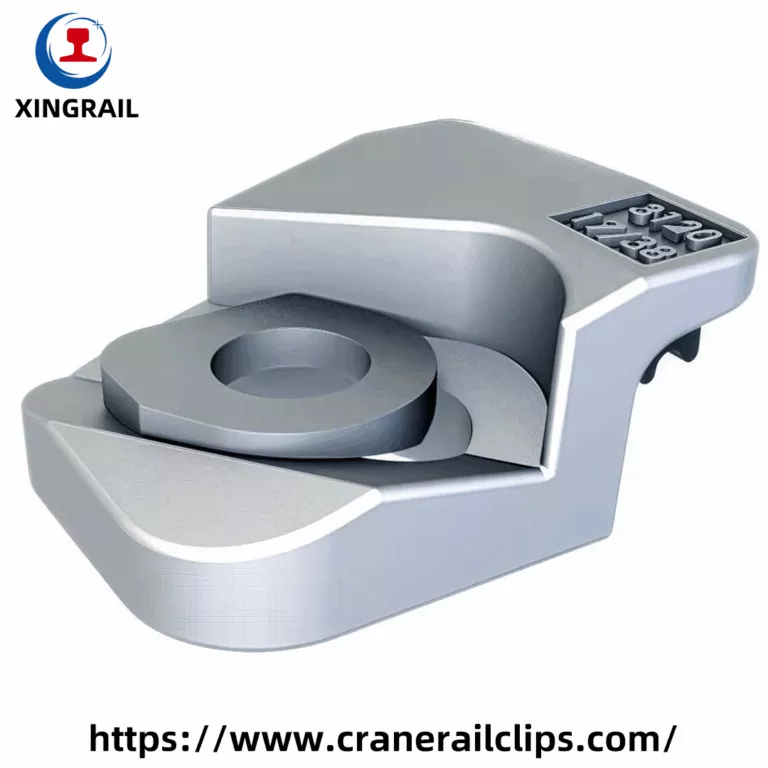
That is why foundry engineers and maintenance managers rely on purpose-built casting crane rail clips — heavy-duty, hot-forged systems engineered specifically for metallurgical environments. As a specialist crane rail clips manufacturer, Xingrail designs and produces these clips to withstand the full brutality of steel plant operation.

Thermal and Dynamic Forces on Ladle Crane Runways
Why Heat Resistance Starts with the Rubber
Most people focus on the steel body of a clip. In foundry runways, the elastomeric component is equally critical. A standard natural rubber pad will begin to lose Shore A hardness above 80°C. It carbonizes and cracks long before your next scheduled maintenance window.
Xingrail’s specialized crane rail pad uses high-temperature vulcanized Chloroprene (Neoprene) and Nitrile compounds, reinforced with internal steel shims. These pads maintain 75° ±5° Shore A elasticity at continuous operating temperatures up to 120°C and can withstand transient radiant spikes to 250°C. That means consistent vibration absorption and rail seat cushioning, no hardening, no crumbling.

Absorbing Extreme Lateral Thrust
Casting crane wheel loads routinely reach 400–700 kN. Emergency braking generates violent lateral thrust loads that push rail sideways against clip faces with enormous force. A lightweight pressed clip offers no meaningful resistance.
Xingrail’s heavy-duty dual-bolt welded-base clips (such as the 9220 series) provide lateral resistance up to 300 kN. The forged Q355B steel body distributes this load into the weldable base and across the girder flange. This is what prevents rail gnawing, progressive misalignment, and catastrophic runway failure.

Matching Heavy Rails: DIN A100, A120, QU100, and QU120
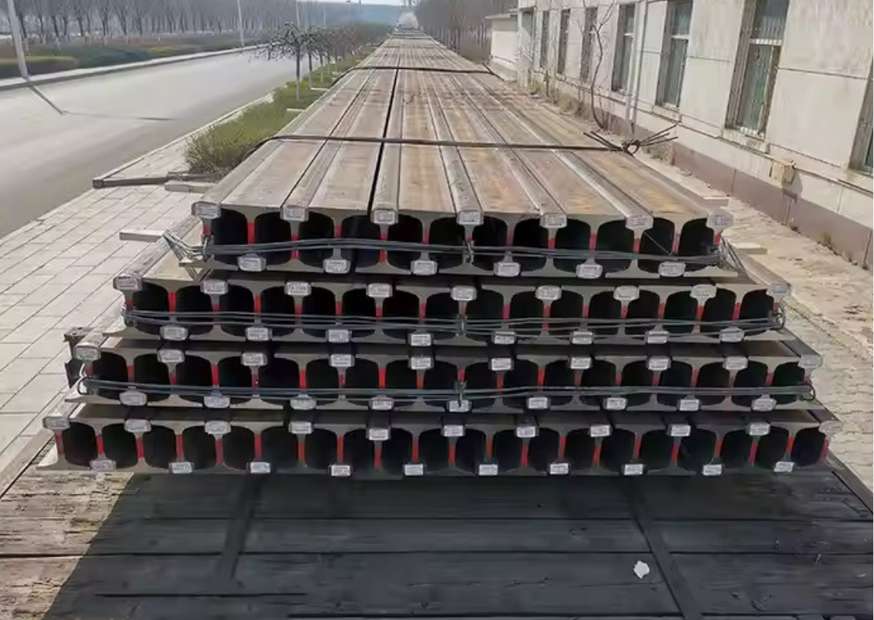
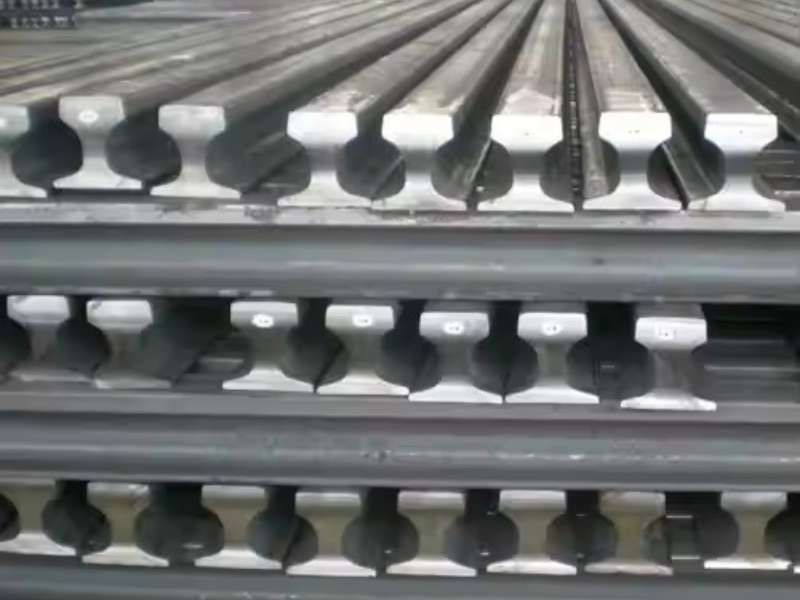
Casting crane runways almost universally use large wide-base heavy rails. DIN 536 A100 and A120 profiles — along with their GB/T equivalents QU100 and QU120 — are the standard choices for ladle and casting crane girders. Their broad foot width and high mass-per-metre provide stability under extreme wheel loads.
Selecting the correct clip model requires matching the rail base width, the girder flange thickness, and the required lateral adjustment range. Heavy-duty clips for din a100 crane rails and A120 profiles typically provide ±15mm to ±20mm lateral adjustment. This allows thermal expansion movement across a long runway span without requiring weld cutting during re-alignment.

To get precise model recommendations and project quantities for your runway, use the interactive rail clips configurator selector. Enter your rail profile, runway length, and maximum wheel load to receive a tailored clip schedule instantly.
Related: intermodal terminal rail clips and rail clamps for cranes.
Weldable Base Installation on Box Girder Flanges
Welding Standards That Protect the Girder
Casting crane runway girders are massive welded box structures. Through-bolting the top flange is often physically impossible — and dangerous where it would compromise flange integrity. Welded rail fixing clips solve this by attaching the base plate directly to the top flange with high-strength fillet welds.
Correct metallurgical practice is essential here. Xingrail recommends preheating the girder flange to 100°C–150°C before welding Q355B or C45 forged bases. Low-hydrogen electrodes must be used throughout. These steps prevent hydrogen-induced cracking in the heat-affected zone (HAZ), a failure mode that can develop silently and cause sudden base detachment under load.

Self-Locking Fasteners That Tighten Under Vibration
Crane runway vibration is relentless. Conventional nuts back off under cyclic loading, even with spring washers. Xingrail clips use a wedge-action self-locking mechanism combined with Grade 10.9 Dacromet-coated high-strength bolts and nuts. The wedge geometry converts lateral vibration energy into additional clamping force. Clips that see thousands of crane passes per year do not loosen.
Runway Alignment Maintenance and ISO 12488-1
Steel plant buildings expand and contract significantly across seasonal temperature swings. Over years of operation, cumulative thermal movement can push runway rails out of tolerance. ISO 12488-1 Class 1 and Class 2 define the permitted deviations for crane runways in terms of span, gauge, and height difference between rails.
Xingrail clips with ±20mm lateral adjustment allow maintenance teams to re-align runway rails without cutting welds or shutting down adjacent bays for extended periods. The eccentric adjustment mechanism enables incremental correction during scheduled maintenance windows, keeping your crane runway within ISO 12488-1 tolerances with minimal downtime.
FAQs
Q1: What makes casting crane rail clips different from standard industrial crane clips?
— Casting and ladle cranes operate directly above molten metal, creating severe radiant heat and cyclic wheel loads up to 700 kN. Casting crane rail clips use Q355B hot-forged steel bodies, heat-stabilized elastomeric rubber pads rated to 120°C continuous, and lateral resistance up to 300 kN to withstand emergency braking forces.
Q2: Which clip models suit DIN A100 and A120 casting crane rails?
— For A100 and A120 profiles, heavy-duty welded-base clips such as the Xingrail 9220/20 or 9124 series are recommended. They provide up to ±20mm lateral adjustment for thermal expansion and use dual Grade 10.9 high-strength bolts.
Q3: How do rubber pads survive extreme ladle heat without degrading?
— Xingrail uses vulcanized Chloroprene and Nitrile compounds reinforced with steel shims. These maintain Shore A 75° elasticity at up to 120°C continuous and 250°C transient radiant spikes — far beyond the capacity of standard commercial rubber.
Q4: Why is a weldable base preferred over through-bolted clips in foundry runways?
— Box girder flanges on casting crane runways are often inaccessible from below, making through-bolting impractical or structurally risky. Weldable base clips attach with high-strength fillet welds using proper preheating, providing a permanent, high-capacity connection to the girder top flange.
Q5: Do Xingrail casting crane rail clips include Mill Test Certificates?
— Yes. Every production batch includes an EN 10204 3.1 inspection certificate covering chemical composition (C, Si, Mn, P, S) and mechanical tensile and yield test results — meeting the documentation requirements of steel plant safety audits and metallurgical design institutes.