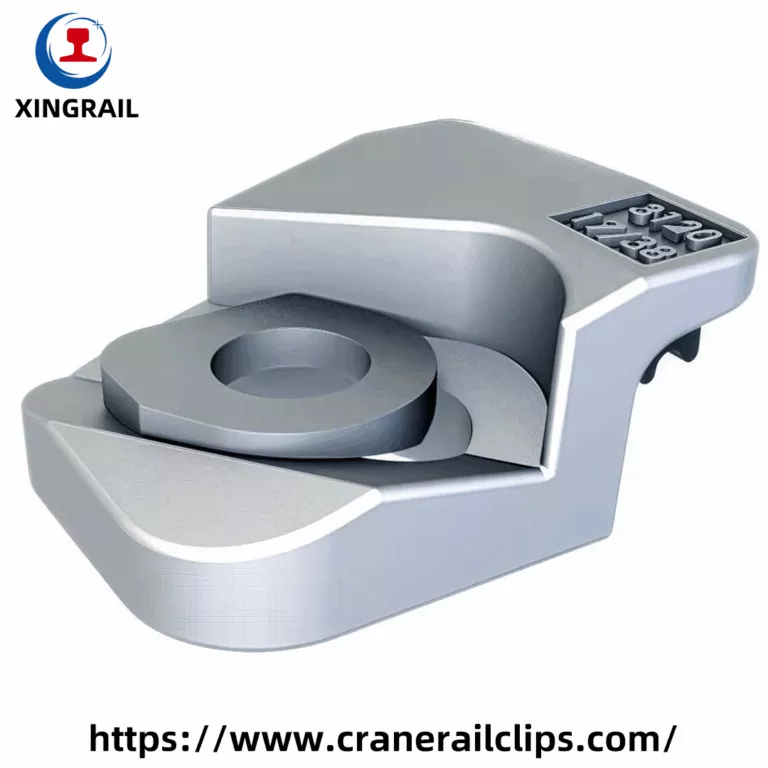
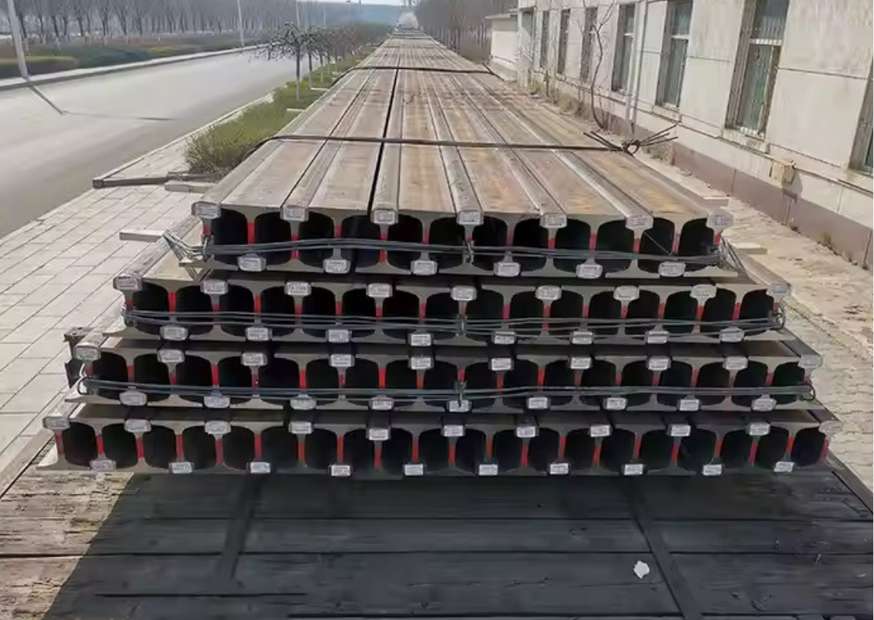
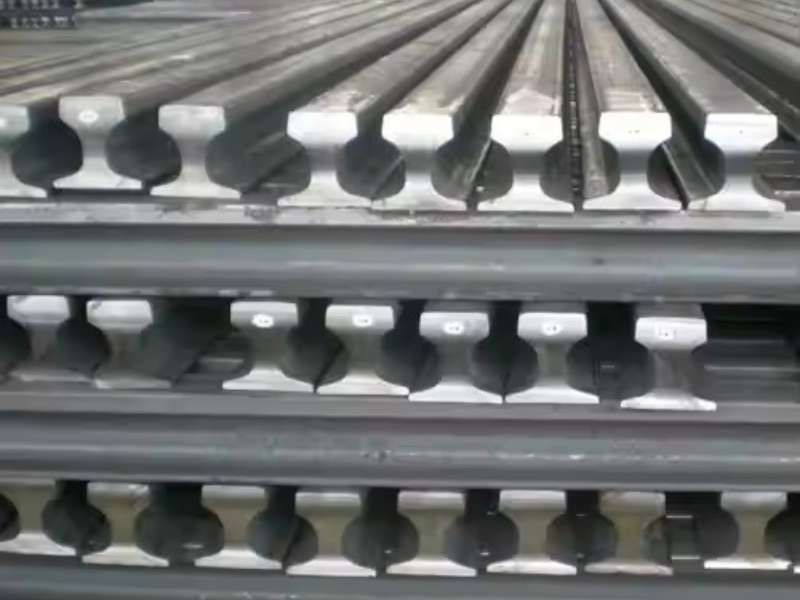
A crane rail end stop is a mechanical device fixed at each end of a crane runway. It arrests the crane before it overruns the rail, protecting the track, the end carriage, and the supporting structure. Specify it by rail type (CR80, QU80, A100, A120), impact energy, buffer stroke, and mounting method.

What Is a Crane Rail End Stop?
A crane rail end stop limits travel distance at the runway’s end. Without it, a travelling crane can damage the track, the end carriage, or the building structure. End stops work together with crane rail clamps that hold the track itself — the two components serve different roles and are not interchangeable.
End stops are typically fitted at both ends of the runway. In some layouts, only one end carries the physical stop while the other end uses a limit switch. Always check your crane’s dynamic braking distance before deciding on stop placement.
Types: End Stop, Stop Block, Buffer Stop and Crane End Stop
The right type depends on crane speed and load.
Rigid end stop / stop block — a fixed, high-stiffness barrier with no travel. It suits low-speed cranes with short braking distances. The stop resists impact directly through its base.
Buffer stop / bumper — adds spring or hydraulic stroke to absorb impact energy. This suits faster cranes and heavier loads, such as EOT cranes in port or steel mill applications. This type of crane end stop reduces peak forces on the structure considerably.
Deceleration stop with limit switch — used where precise positioning matters. The crane slows over a set distance before it reaches the physical stop.

How to Select a Crane Rail End Stop
| Parameter | Rigid Stop | Buffer Stop |
|---|---|---|
| Rail type | CR80, QU80, A100, A120 | Same |
| Buffer stroke | ≈0 (rigid) | Per drawing |
| Mounting | Welded / bolted | Welded / bolted |
| Typical use | Low speed, indoor | High speed, heavy load |
Start with your rail type and height. Then calculate the actual impact energy from crane speed and loaded weight. Finally, choose welded or bolted mounting based on your foundation type.
Refer to the CR 80 rail dimensions page to match the stop’s seating face to your rail height. All stop geometry must align with the rail foot and base width, consistent with how other railway track components are specified.
Installation and Alignment
Good installation protects both the stop and the entire runway.
Space rail clips correctly. At end stops, joints, and curves, tighten clip spacing to 400–500 mm. This is integral to the complete rail clamping system, not just a local precaution.
Align to the track centre line. Offset mounting causes side loading and accelerated wear on the stop base.
Choose the right base type. On steel beams, welded bases are preferred. On concrete foundations, follow the same logic as bolted crane rail anchoring — use embedded bolts or resin anchors.
Commission with the limit switch. The stop is the last line of defence. The limit switch must slow the crane before impact occurs. Test both together before handing over the runway.
For the fixing hardware on either side of the stop, a forged rail fastening clamp provides the correct rail-foot grip.

Common Mistakes
Using a rail clamp as a stop. Clamps resist vertical and lateral forces, not end-of-travel impacts. They will fail under repeated collision loads.
Skipping the energy calculation. Choosing a stop by rail type alone, without calculating impact energy, routinely leads to undersized hardware and structural damage.
Mismatched rail height. If the stop’s bearing face does not match the rail head or foot width, the load path is incorrect and the stop can rotate or shear under load.
Fitting only one end. Both ends need protection unless a fail-safe limit switch covers the open end. A single stop on one end is a safety gap, not a solution.
Sourcing from Xingrail
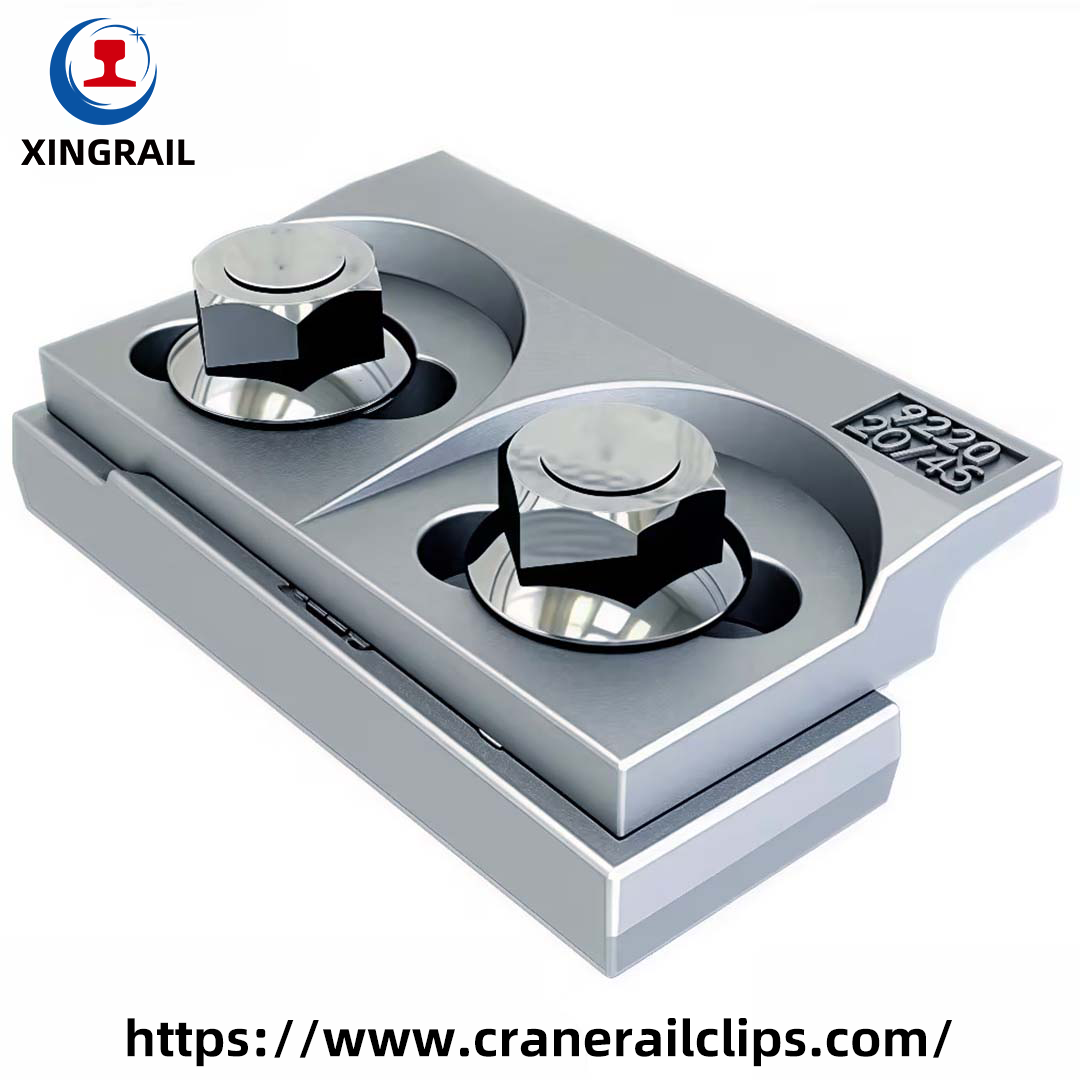
Xingrail supplies crane rail end stops alongside matching clamps and base plates as a complete package. Provide your rail type or a technical drawing and the stop is manufactured to suit. Material certificates and test reports ship with every order. Contact the team with your rail type, crane parameters, and quantity for a quotation.

Frequently Asked Questions
Q1: What is a crane rail end stop used for?
It is fixed at the end of a crane runway to arrest the travelling crane before it overruns the rail, protecting the track, the end carriage, and the supporting structure.
Q2: What is the difference between a crane end stop and a buffer stop?
A rigid end stop (or stop block) resists the load directly with no travel. A buffer stop adds spring or hydraulic stroke to absorb impact energy — better suited to faster or heavier cranes.
Q3: How do I choose the right end stop for my rail type?
Identify your rail type (CR80, QU80, A100, A120) and height. Calculate impact energy from crane speed and loaded weight. Then choose rigid or buffer type and confirm the mounting method.
Q4: Should crane rail end stops be welded or bolted?
Welded bases suit steel beams and heavy-duty applications. Bolted or embedded bases suit concrete foundations and retrofit work where the runway gauge may be adjusted later.
Q5: Can you supply a crane rail end stop to my drawing?
Yes. Provide your rail type or drawing for a custom-made stop, supplied with material certificates and inspection reports.