Knowing European rail gauges is important to understanding the continent’s complicated railway systems. Europe has a great variety of railway track widths due to narrow and broad gauges. That’s why What are the different rail gauges used in Europe? And Why do European countries have varying rail gauges? These variances affect train operations and connection due to gauge compatibility and infrastructural issues. This reference covers conventional rail gauge measurements, gauge discrepancies, and how Europe manages them for cross-border railway operations.
What Are the Common Railway Gauges in Europe?
The historical, geographical, and technical elements that shaped European railways have produced a diverse variety of gauges. Many European countries are connected by the standard gauge, 1,435 mm, the most prevalent rail gauge. Narrow gauge railways, with track widths below 1,435 mm, are common in mountainous areas and offer cost-effective options. The disparities in European railway track widths are highlighted by the prevalence of broad gauge railways in countries like Spain and Portugal. These changes show how complicated continental rail gauge compatibility is.
Europe’s rail gauge variances generate concerns regarding train operations and infrastructure. What are the different rail gauges used in Europe? And Why do European countries have different rail gauges? are important questions. The patchwork of gauges is due to historical decisions and regional demands. Innovative solutions like changeable wheelsets and gauge-changing facilities are needed to ensure rail gauge compatibility. In order to retain connectivity and operating efficiency, European railway infrastructure must also adapt to these changes. For one to fully appreciate the complex dynamics of European rail gauge standards, it is important to comprehend these characteristics.
How Does the Rail Gauge in the UK Differ From Europe?
The UK uses the standard 1,435 mm rail gauge, like most of Europe. The UK railway system is unusual due to its history and infrastructure constraints. Standard rail gauge Europe guarantees compatibility across many countries, although the UK’s older railway lines sometimes have tighter curves and lower loading gauges. This divergence underlines the difficulty of rail gauge compatibility throughout Europe, notably for Channel Tunnel cross-border operations.
European rail gauge variances are obvious in operational procedures and technical specifications while sharing the same standard gauge. European train track dimensions can support larger and heavier trains, but UK railways favor smaller designs to meet its ancient infrastructure. The UK relies on standard gauge, hence narrow gauge railways Europe are rare. For international services like Eurostar. This interaction highlights the difficulty of rail gauge variations throughout Europe and the need for inventive ways to preserve communication.
What Is the Standard European Railway Gauge?
Most European railway networks use the 1,435 mm standard gauge. Euro standard gauge guarantees interoperability and efficiency in cross-border train operations. Germany, France, and Italy depend on this gauge for smooth network and border connectivity. This standard has helped improve European railway infrastructure. Rail gauge variations in Europe still persist. Some countries have adopted other gauges for topographical or historical reasons, despite the universal usage of the standard rail gauge Europe. Broad gauge railways in Europe, such as those in Spain and Portugal, have broader track widths to satisfy engineering preferences.
Mountains require tighter curves and lower building costs, hence narrow gauge railways Europe are prevalent. These variances show the complexity of rail gauge compatibility in Europe, where trains must adjust to different European railway track widths. Innovative gauge-changing equipment and specialist rolling stock are needed to manage rail gauge variances in Europe and provide efficient and reliable rail services.
Partner With Xingrail to Provide a Wide Range of Railway Tracks
Partnering with Xingrail provides access to a wide choice of railway tracks for European rail gauges. At Xingrail, we provide railway tracks tailored to European rail gauge standards. Our expertise covers standard, narrow, and broad gauge systems. We focus on solving compatibility challenges and ensuring smooth operations. With high-quality products and customized services, we help clients optimize railway performance. Partner with us to achieve efficient and reliable railway infrastructure solutions.
Recommended Products for European Rail Gauges
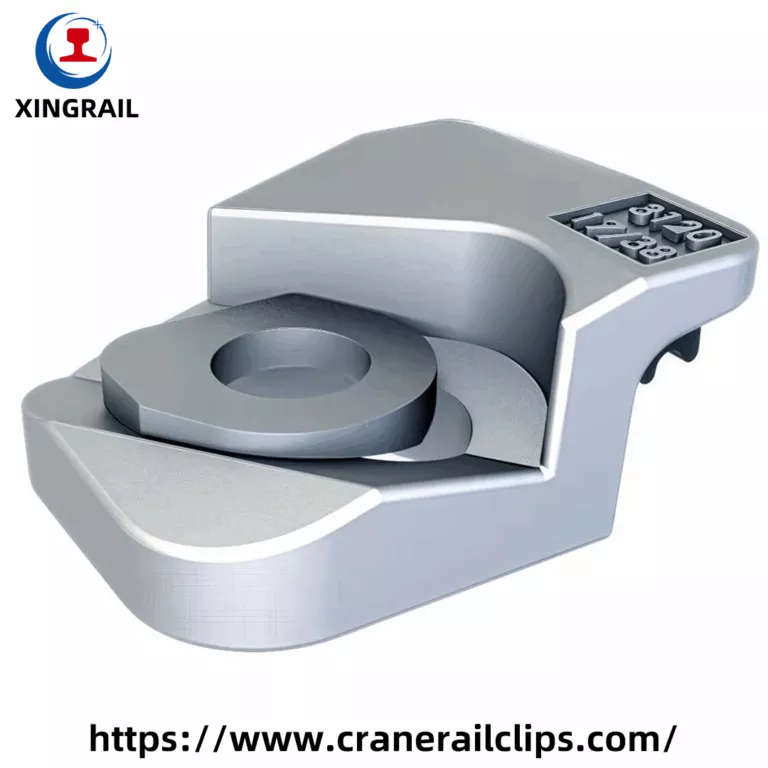
Understanding the complex network of European rail gauges is only the first step in building a secure railway. Whether you operate on the standard 1,435 mm gauge that connects Germany and France, or the broad gauge tracks found in Spain and Portugal, track stability relies entirely on your fastening system.
While the track gauge defines the distance between the train wheels, your rail clip selection depends solely on the physical base width of your rail profile. To lock the track in place and prevent dangerous gauge widening, your rail clip must sit flush against the rail foot. This precise fit allows the fastener to apply heavy downward clamping force, pinning the rail to the sleeper and absorbing the severe dynamic vibrations of cross-border trains.
To help you maintain seamless operations across Europe, we have matched our premium crane rail clips with the prominent UIC rail profiles used throughout the continent. Review the table below to find the correct fastening system for your exact rail dimensions.
|
Rail Type |
Base Width |
Height |
Weight |
Recommended Clips |
|
UIC 54 (54E1) |
140.0 mm |
159.0 mm |
54.77 kg/m |
32 Series Bolted Rail Clips |
|
UIC 60 (60E1) |
150.0 mm |
172.0 mm |
60.21 kg/m |
9 Series Welded Rail Clips |
For more detail on this subject, see rail gauge by country and UK rail gauge against Europe.
Frequently Asked Questions (FAQs)
- Do broad gauge railways in Spain and Portugal require different rail clips than standard gauge lines?
No, the track gauge measurement does not change which rail clip you need. You must select your rail fasteners based entirely on the cross-sectional dimensions of your rail profile. If a broad gauge track and a 1,435 mm standard gauge track both use the European UIC 60 rail profile, they will both require the exact same 9 Series Welded Clips to secure the 150.0 mm base. - How do elastic rail clips maintain the 1,435 mm standard European track gauge?
As heavy international trains travel across borders, their wheels push outward against the rails with immense lateral force. Our elastic fastening systems counter this outward push by applying a constant, heavy clamping force directly onto the rail foot. This intense friction firmly pins the rail to the sleeper, actively preventing the lateral movement that widens track gauge. - Why do high-speed European networks using UIC 60 rails need 9 Series Welded Clips?
High-speed passenger trains across France, Germany, and Italy generate intense dynamic vibrations. The UIC 60 rail features a broad 150.0 mm base designed specifically to handle these extreme loads. You weld the 9 Series clips directly to the underlying steel tie plates. This creates a rigid, permanent bond that safely locks the tracks against severe high-speed impacts. - Are 32 Series Bolted Clips suitable for older UK railway lines with tighter curves?
Yes. While the UK uses the European standard gauge, its older infrastructure often features tighter curves and narrower loading limits. Engineers frequently use the UIC 54 rail profile on these routes. The 32 Series Bolted Clips fit the 140.0 mm base of this rail perfectly. They deliver exceptional grip on curved tracks while allowing maintenance teams to easily loosen the bolts and adjust the track alignment. - What happens to cross-border train operations if I install mismatched rail clips?
Using a rail clip that fails to match your rail’s specific base width creates an immediate derailment risk. If you place a clip engineered for a 140.0 mm base onto a wider 150.0 mm rail, the fastener will not seat flush. You will instantly lose the necessary clamping force. The passing trains will quickly shake the unsecured rails loose, ruining gauge compatibility and forcing cross-border traffic to a halt.