Rail gauge is very important in railway engineering because it affects how well the network works and how compatible it is. Xingrail is a professional manufacturer that makes high-quality rail tracks for a range of gauges, including those used in the UK rail gauge vs Europe. This article talks about the different types of rail gauge systems and how they affect infrastructure and interoperability.
What is Rail Gauge?
The rail gauge shows how far apart the rails are on a railroad track. Engineers measure it between the inner edges of the load-bearing rails. Gauge selection influences almost every facet of railway design and operation. For instance, it affects the potential for network expansion, infrastructure construction costs, and vehicle design.
Rail gauge standardization is important. It makes it easier for rolling stock from various railway systems to work together. At border crossings, passengers and cargo must be moved from one train to another in the absence of a common gauge. This procedure is expensive and time-consuming. International travel and trade are greatly facilitated by a standardized Europe rail gauge. To put it briefly, it makes the transportation system more cohesive and effective.
There are three main types of rail gauges found all over the world:
Wide Gauge: The standard 1,435 mm gauge is narrower than this one. Several types of broad gauge are used in nations like Portugal, Finland, Spain, and Russia.
Standard Gauge: 1,435 mm (4 feet 8.5 inches) is the most widely used gauge in the world. China, much of Europe, and most of North America use it.
Narrow Gauge: This category includes any gauge that is less than 1,435 mm. It is frequently utilized for industrial railways or in mountainous areas where space and cost are significant limitations.
What is UK Rail Gauge
The standard gauge of 1,435 mm is widely used in the United Kingdom. Due to historical factors dating back to the early 19th century, this dimension became the UK railway gauge. Railroad pioneer George Stephenson chose this gauge for the Stockton and Darlington Railway, the first steam-locomotive-powered public railway in history. Its success encouraged the nation to adopt this gauge widely.
There are numerous advantages to using a standard track gauge UK. It enables rolling stock and track components to be compatible with an extensive worldwide supply chain. The rail system in the UK, however, has particular difficulties. In comparison to mainland Europe, the UK has a lower “loading gauge,” or the maximum height and width of railway vehicles. This is a holdover from the early days of tunnel and bridge building. Because of this, even though the rail gauge is the same, many European trains are unable to run on UK tracks. In the UK rail gauge vs. Europe debate, this loading gauge restriction is important.
What is Rail Gauge in Europe
The standard gauge of 1,435 mm is the most widely used rail gauge in Europe. To improve cross-border connectivity, the European Union has promoted this gauge as the benchmark for its Trans-European Transport Network (TEN-T). The smooth flow of people and products throughout the continent is made possible by this standardization. It is, in fact, a fundamental component of European transportation policy.
There are some noteworthy exceptions to this rule, though. The Iberian gauge. The gauge used in Ireland is 1,600 mm. Additionally, a 1,520 mm Russian gauge is used by nations in the former Soviet Union, such as the Baltic states. At international borders, breaks-of-gauge are caused by these variations in railway gauges in Europe.
Cross-border rail connectivity is severely hampered by these gauge discrepancies. Railways employ a number of strategies to get around this. These include bogie exchange stations, where train cars’ wheelsets are swapped out. Variable gauge axle systems are an additional solution. When switching between gauges, these enable trains to automatically modify their wheel spacing. In an effort to better integrate with the rest of Europe, Spain has been constructing its high-speed rail network using standard gauge.
Key Differences Between UK and European Rail Gauge
The widespread adoption of the 1,435 mm standard gauge is the most obvious similarity between UK rail gauge and Europe. The foundation for possible interoperability is this common standard. In theory, trains designed for this track width can be used in the UK and the majority of mainland Europe. This makes the production and acquisition of rolling stock and track materials easier.
Infrastructure varies significantly despite the common track gauge. The loading gauge is the most important difference. The loading gauge in the UK’s infrastructure is more constrained. This restricts the size of trains that can run on its network. As a result, most UK lines cannot accommodate double-decker trains. The electrification systems represent yet another significant distinction. Railways in the UK combine third-rail power systems with overhead lines. In contrast, most mainland European networks use standardized overhead line voltages.
|
Feature |
United Kingdom |
Mainland Europe (Majority) |
Key Differences/Similarities |
|
Standard Rail Gauge |
1,435 mm (Standard Gauge) |
1,435 mm (Standard Gauge) |
Similarity: Both predominantly use standard gauge, enabling potential interoperability. |
|
Notable Gauge Exceptions |
Limited (heritage lines) |
Iberian Peninsula (1,668 mm), Ireland (1,600 mm), Finland/Baltic States (1,520 mm) |
Difference: Mainland Europe has larger regions with non-standard gauges creating break-of-gauge issues. |
|
Loading Gauge |
Restrictive, smaller profile due to older infrastructure (bridges, tunnels) |
More generous, allowing for larger rolling stock like double-decker trains. |
Difference: A major barrier. UK loading gauge prevents many European trains from operating on its network. |
|
Electrification |
Mix of 25 kV AC overhead lines and 750 V DC third rail. |
Predominantly standardized AC overhead systems (e.g., 25 kV AC, 15 kV AC). |
Difference: Lack of a single standard in the UK complicates cross-border operations. |
|
Signaling System |
Historically unique national system, gradual migration to ERTMS. |
Strong push for standardization with the European Rail Traffic Management System (ERTMS). |
Difference: Different signaling systems require multi-system-equipped trains for cross-border travel. |
|
Interoperability |
Limited by loading gauge, electrification, and signaling. Primarily through the Channel Tunnel. |
High degree of interoperability in standard gauge areas, facilitated by EU policies. |
Difference: Far greater practical interoperability exists within mainland Europe than between the UK and the continent. |
For a deeper look at the subject, see Indian standard rail dimensions.
Frequently Asked Questions
1. Are rail gauges in the UK and Europe the same?
Yes, for the most part. The standard gauge of 1,435 mm is used in the UK and most of Europe. However, significant differences in loading gauge and electrification prevent most European trains from running in the UK.
2. Why does Spain have a different rail gauge?
Spain, along with Portugal, historically used the wider Iberian gauge (1,668 mm). This decision was made in the 19th century, in part to increase the difficulty of a possible rail-based invasion from France. In order to keep up with the rest of Europe, Spain is currently constructing its high-speed network using standard gauge.
3. What is the standard rail gauge in Europe?
In most of Europe, 1,435 mm (4 feet 8.5 inches) is the standard rail gauge. The European Union promotes this as the standard for major international and high-speed lines to ensure interoperability.
4. Is it possible for a UK train to operate in Europe?
Certain UK trains, such as the Eurostar, are made expressly to run in both the UK and continental Europe. These trains are built to comply with the UK’s restrictive loading gauge while also being compatible with European signaling and electrification systems. However, a typical UK domestic train cannot run in Europe.
5. What are the main railway gauges in Europe?
The Standard gauge (1,435 mm), Iberian gauge (1,668 mm), Irish gauge (1,600 mm), and Russian/Finnish gauge (1,520/1,524 mm) are the primary railway gauges in Europe.
Recommended Products for UK and European Rail Networks
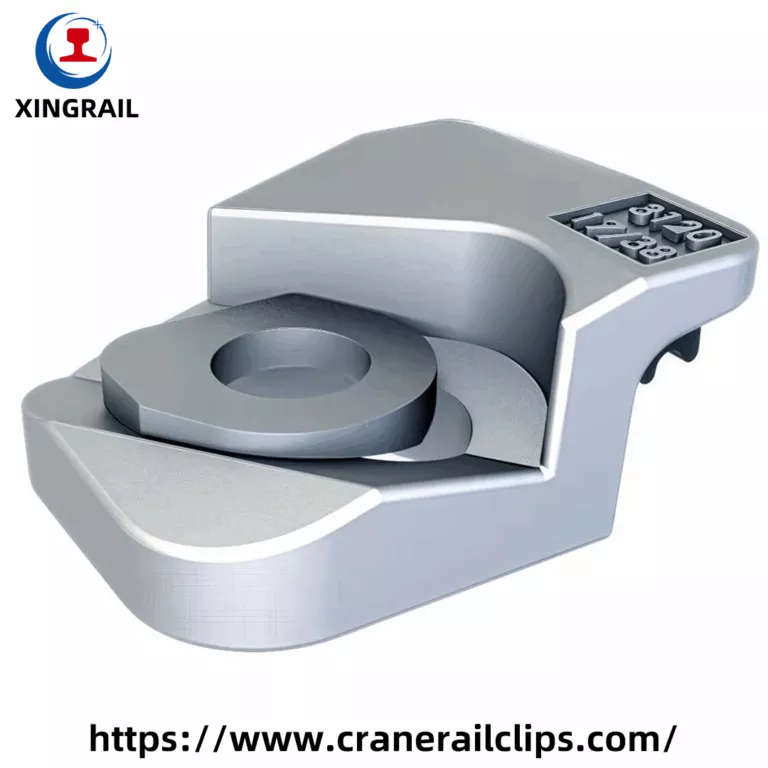
While the United Kingdom and mainland Europe share the widespread 1,435 mm standard rail gauge, securing these sprawling networks requires precise engineering. The track gauge defines the distance between the two running rails, but it does not determine your fastening system. To build a safe and resilient railway, you must match your rail clips directly to the physical base width of your specific rail profile.
Whether you operate trains across the European Trans-European Transport Network (TEN-T) or manage domestic routes within the UK, your rail clip must sit completely flush against the rail foot. This precise fit allows the fastener to apply a continuous, heavy downward pressure known as toe load. This immense clamping force anchors the rail firmly to the sleeper or baseplate, absorbing high-frequency vibrations and actively preventing the lateral forces of passing trains from widening the 1,435 mm gauge.
To help you maintain stability across your standard gauge infrastructure, we have paired our premium rail clips with the common UIC rail profiles utilized throughout the UK and Europe. Review the table below to find the correct fastening solution for your track dimensions.
|
Rail Type |
Base Width |
Height |
Weight |
Recommended Clips |
|
UIC 54 (54E1) |
140.0 mm |
159.0 mm |
54.77 kg/m |
32 Series Bolted Rail Clips |
|
UIC 60 (60E1) |
150.0 mm |
172.0 mm |
60.21 kg/m |
9 Series Welded Rail Clips |
Frequently Asked Questions (FAQs)
- Does the 1,435 mm standard gauge used in the UK and Europe determine my rail clip selection?
No, the track gauge measurement strictly defines the distance between the rail heads. You must choose your fasteners based entirely on the base width of your specific rail profile. A perfect fit on the rail flange ensures the clip delivers the necessary holding power, regardless of the track gauge. - Are 32 Series Bolted Clips suitable for standard gauge tracks in the UK?
Yes. Track engineers frequently specify standard rail profiles like the UIC 54 for mixed-traffic operations. This rail features a base width of 140 mm, which perfectly matches the gripping range of the 32 Series Bolted Clips. They provide heavy downward pressure while allowing track crews to easily loosen bolts during routine maintenance. - Why do heavy-duty European networks using UIC 60 rails require 9 Series Welded Clips?
High-capacity European lines frequently utilize massive UIC 60 rails to support heavy axle loads and high-speed trains. These operations generate severe lateral side-thrusts. You weld the 9 Series clips directly to the steel foundation to create an unyielding structural anchor. This rigid grip flawlessly accommodates the 150 mm rail base and safely neutralizes extreme dynamic forces. - How do rail clips maintain the 1,435 mm standard gauge across European borders?
Passing trains push outward against the tracks, creating intense lateral thrust that attempts to widen the gauge. Premium elastic fasteners apply a heavy, continuous downward toe load directly onto the rail base. This immense friction locks the rail in place and actively resists lateral movement, keeping the track width perfectly constant. - Do the restrictive UK loading gauges impact which rail clip I should install?
The loading gauge dictates the maximum height and width of the railway vehicles, preventing larger European trains from operating on UK tracks. However, the loading gauge does not impact your rail clip selection. You always select your fastening system based on the physical dimensions of the steel rail profile itself.