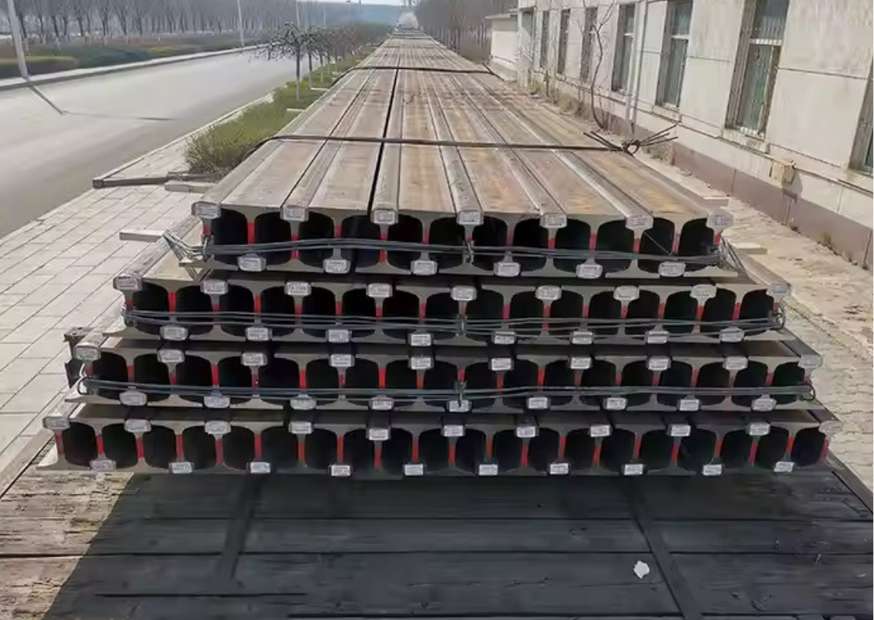
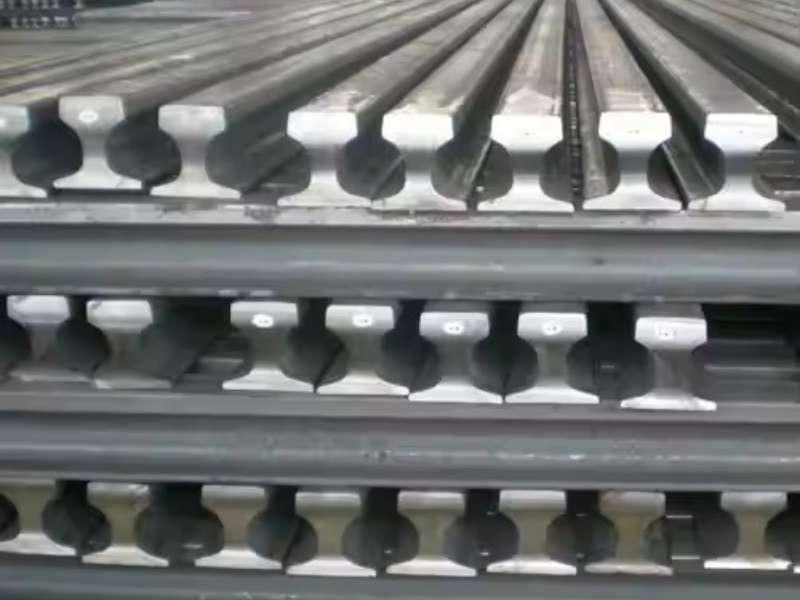
Securing heavy lifting equipment requires precision, strength, and highly reliable infrastructure. The stability of your runway system ultimately dictates the safety and efficiency of your entire facility. Even a minor deviation in rail alignment can cause severe structural damage, costly equipment downtime, and significant workplace hazards. Choosing the right overhead crane rail fastening systems stands as a critical engineering decision for any heavy industrial operation.
Among the most resilient and reliable fastening options available, overhead crane rail clips deliver unmatched stability. This comprehensive guide explores the mechanical design, industrial applications, and engineering advantages of modern rail clips for overhead cranes. Whether you operate a steel plant, manage a busy shipyard, or procure materials for structural engineering projects.
What Are Overhead Crane Rail Clips?
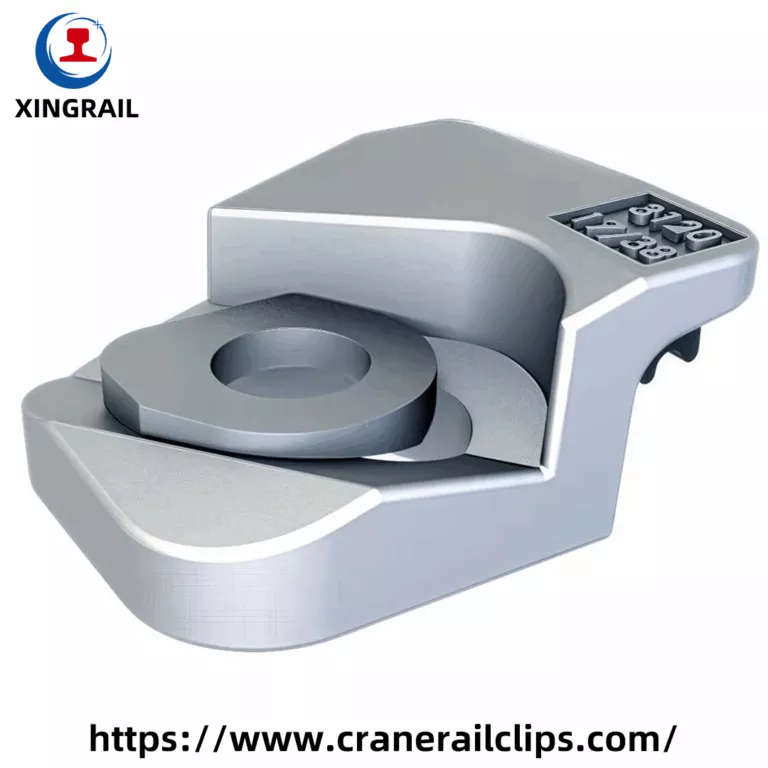
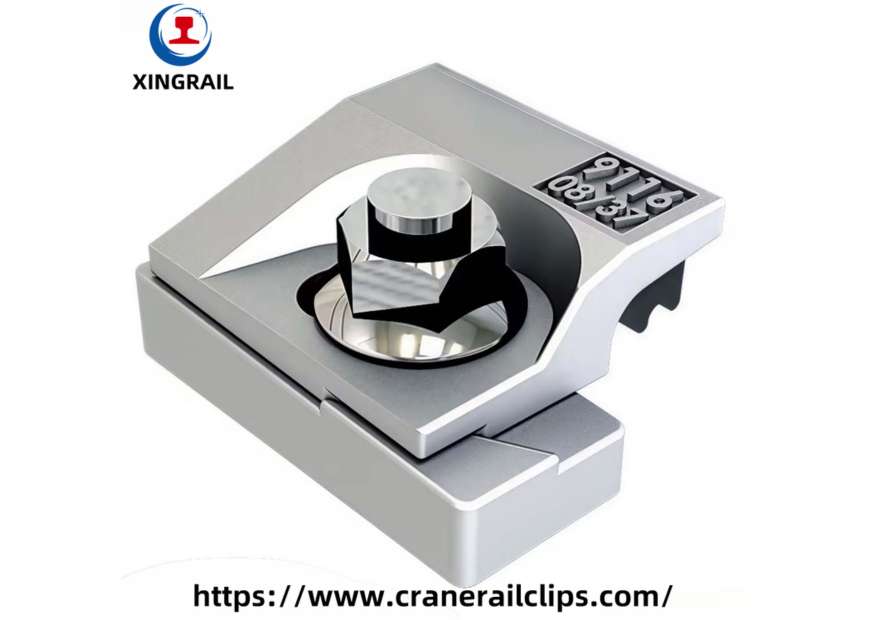
Overhead crane rail clips are highly specialized mechanical fasteners engineered to secure crane rails to underlying steel girders or concrete foundations. These industrial overhead crane rail clips generally consist of two primary components. The first is a robust lower base that firmly attaches to the runway surface. The second is a removable upper clip fitted with a vulcanized rubber nose. A high-strength structural bolt securely connects these two pieces.
These robust fasteners serve as critical components for crane runway systems. They effectively lock the track in place while simultaneously allowing for minor longitudinal thermal expansion. The vulcanized rubber nose actively presses down on the lower flange of the rail. This flexible contact point absorbs damaging dynamic vibrations and stops the rail from shifting under extreme payloads. Reliable overhead crane rail clips ensure your track remains perfectly straight, level, and firmly fastened.
Common Challenges in Crane Rail Installation
Building and maintaining a functional crane track presents a variety of mechanical and environmental challenges. Proper heavy-duty overhead crane clips must successfully mitigate several typical engineering problems:
- Rail misalignment: Poor track alignment accelerates wheel wear and introduces dangerous stress levels to the crane’s structural frame.
- Vibration and impact loads: Massive cranes generate intense dynamic forces. Without adequate absorption, these recurring impacts rapidly degrade the steel runway beam over time.
- Structural fatigue: Rigid, inflexible fastening setups fail to distribute stress evenly. This eventually leads to metal fatigue and catastrophic fastener failure.
- Rail movement: Subpar fasteners allow rails to creep longitudinally or shift laterally when subjected to heavy lifting cycles.
- Maintenance difficulties: Because runway beams sit high above the facility floor, frequent maintenance remains both highly dangerous and expensive.
Utilizing premium overhead crane rail clips directly resolves these ongoing issues. The rubber-tipped upper components dampen harsh vibrations, while built-in adjustable cam mechanisms empower engineers to fine-tune lateral alignment effortlessly. This greatly reduces structural fatigue and significantly extends the lifespan of the entire overhead crane rail support systems.
Welded vs Bolted Crane Rail Clips
When designing a robust track system, engineers must carefully choose between welded and bolted fastening mechanisms.
Welded crane rail clips feature a solid steel base that you weld directly to the supporting steel girder. They offer superior lateral force resistance. Weldable clips represent the preferred engineering solution when working with continuous steel beams. They completely eliminate the risk of base bolts vibrating loose over time.
Bolted crane rail clips are secured using heavy-duty bolts that pass through pre-drilled holes in the steel beam or anchor deep into a concrete foundation. Bolt-on clips serve as the ideal solution when welding is strictly prohibited, such as in highly explosive chemical environments. They also prove necessary when mounting tracks directly to concrete surfaces where welding is impossible.
Recommended XINGRAIL Crane Rail Clips
Selecting the optimal clip depends heavily on your specific load requirements and rail profiles. XINGRAIL manufactures several highly engineered adjustable overhead crane rail clips designed for intense industrial applications.
Our recommended solutions include the bolted 31 and 32 series, as well as the welded 9 and 7 series. Key models include the XINGRAIL 3116/13/36, 3120/17/38, 3224/20/44, 3222/17/44, and 3220/17/38 for bolted applications. For welded setups, we recommend the XINGRAIL 9220/20/45, 9216/08/40, 9120/15/38, 9116/08/3, and the 7216/20/39.
Below is a detailed technical comparison of highly recommended XINGRAIL models:
|
Model |
Base Material |
Surface Treatment |
Lateral Force Resistance |
Horizontal Adjustment |
Applications |
Special Features |
|
Forged Steel |
Zinc Plated / Bare |
75 kN |
10 mm |
Overhead cranes |
Compact base design |
|
|
Forged Steel |
Hot Dip Galvanized |
125 kN |
15 mm |
Heavy steel mills |
High impact resistance |
|
|
Forged Steel |
Zinc Plated |
165 kN |
20 mm |
Port gantry cranes |
Self-locking mechanism |
|
|
Forged Steel |
Anti-corrosion Paint |
100 kN |
15 mm |
Automated warehouses |
Vulcanized rubber nose |
These advanced adjustable overhead crane rail clips provide the important flexibility needed during installation. Once properly torqued, they guarantee maximum holding power to keep your operations running safely.
Compatible Crane Rails and Track Standards
A highly versatile fastening system must seamlessly adapt to various global engineering standards. Premium overhead crane track rail clips are explicitly engineered for broad compatibility with international rail profiles.
These heavy-duty clips easily secure DIN536 crane rails. They are also entirely compatible with AREA crane rails frequently used in North America, alongside BS railway tracks standard in the UK. Furthermore, these fasteners flawlessly accommodate China standard rails (QU series), Indian standard rails (CR series), GOST rails, SABS rails, and Australian standard rails.
For more detail on this subject, see rail fastening clips and rail fixing hardware for cranes.
Typical Applications of Overhead Crane Rail Clips
Heavy-duty overhead crane rail clips are fundamental to the daily operations of numerous rigorous industrial sectors. They support high-capacity lifting in environments that demand absolute precision and reliability.
- Container ports: Ship-to-shore cranes demand massive, highly stable tracks to safely handle continuous loading and unloading cycles.
- Shipyards: Huge gantry cranes transport enormous ship blocks, necessitating tracks that maintain absolute alignment under shifting loads.
- Steel mills: Scrap yard and ladle cranes operate continuously in extreme high-heat and high-vibration environments.
- Automated warehouses: Stacker cranes rely on absolute precision to retrieve stored goods quickly without jamming the retrieval system.
- Mining facilities: Heavy extraction equipment depends on durable rails to transport raw materials safely across difficult terrain.
- Heavy manufacturing plants: Overhead assembly cranes require flawless track operations to move heavy machinery components safely across the factory floor.
In these demanding environments, heavy-duty overhead crane rail clips are widely used because they deliver the highest lateral force resistance available. They keep heavy operations running safely without requiring constant track realignment or costly downtime.
Installation Best Practices for Crane Rail Clips
Executing a precise installation is necessary to guarantee the long-term performance of your infrastructure. Always follow these proven engineering best practices:
- Welding procedures: You must weld the base of weld-on crane rail clips to the steel beam using proper structural welding techniques and low-hydrogen electrodes. Always ensure the steel beam surface is completely clean and free of rust or oil.
- Bolting methods: Once the base is securely welded or bolted down, position the upper clip directly over the base and insert the high-strength bolt.
- Rail alignment procedures: Before applying final torque to the bolts, utilize the cam mechanism on the adjustable overhead crane rail clips to push the rail into perfect horizontal alignment.
- Tightening torque recommendations: You must always use a recently calibrated torque wrench. Tighten the specific bolts to the manufacturer’s exact specified torque to compress the rubber nose properly without yielding the fastener.
- Inspection and maintenance: You should routinely inspect the overhead crane rail clips for visible signs of excessive wear, loose bolts, or degrading rubber components.
Why Forged Crane Rail Clips Improve Durability
Not all rail fasteners deliver the same level of performance. Forged steel clips offer massive mechanical advantages over traditional cast iron alternatives. The specialized high-pressure forging process naturally aligns the internal grain structure of the steel. This results in exceptionally higher tensile strength and far better overall structural integrity.
This improved metallurgy directly translates to superior fatigue resistance. Furthermore, when combined with the vulcanized rubber nose, forged clips provide excellent vibration absorption. This winning combination significantly extends the longer service life of both the supporting runway beam and the expensive crane wheels.
Heavy Duty Overhead Crane Rail Clips for Gantry Cranes
Enormous gantry cranes and massive container handling cranes exert immense lateral forces on their tracks. These forces stem from intense wind loads, rapid crab trolley movements, and the inevitable pendulum swinging of heavy payloads. Modern overhead crane rail clips are specifically engineered to handle these intense, multi-directional forces safely.
By firmly securing the rail to the continuous runway beam or embedded steel floor plates, the system creates a rigid. This prevents the rail from dangerously overturning or shifting laterally under the massive operational weight of modern gantry cranes.
How to Install Overhead Crane Rail Clips on Crane Runway Beams
Executing a flawless installation on a continuous steel beam involves a highly systematic approach. Proper execution ensures the track system functions safely for years.
- Preparation: Vigorously clean the steel runway beam to ensure a proper welding or bolting surface. Accurately mark the exact center line of the track layout.
- Positioning the Rail: Carefully lower the crane rail onto the beam, supported by a resilient continuous rubber pad if specified by your structural engineers.
- Positioning the Base: Place the lower bases of the overhead crane rail clips on both sides of the rail flange at the specified uniform spacing intervals.
- Welding or Bolting: Securely fasten the bases to the steel runway beam. Never weld the base directly to the rail itself, as this prevents necessary thermal expansion.
- Installing Upper Clips: Place the upper clip components carefully onto the secured bases.
- Alignment: Adjust the built-in cam mechanisms to secure the rail tightly and verify it perfectly follows the established center line.
- Final Torque: Torque all bolts to officially lock the overhead crane rail clips in their final operational position.
Best Overhead Crane Rail Clips for DIN536 Crane Rails
DIN536 crane rails feature a remarkably wide base and a low, stocky profile. Overhead crane rail clips are perfectly suited to secure these specific profiles.
Whether your facility uses A45, A55, A65, or A75 rails for standard medium-duty applications, or massive A100, A120, and A150 rails for extreme industrial loads, there is a dedicated clip designed to fit perfectly. The upper clip’s vulcanized rubber nose is precisely angled to match the specific slope of the DIN536 rail flange. This meticulous design ensures maximum surface contact and superior anchoring capabilities.
FAQs
- What are overhead crane rail clips used for?
They are heavily engineered mechanical fasteners used to securely attach crane rails to steel or concrete runway beams. They prevent dangerous lateral track movement while safely accommodating longitudinal thermal expansion. - What is the difference between welded and bolted crane rail clips?
Welded clips feature a robust steel base permanently welded to the supporting beam. Bolted clips rely entirely on heavy-duty bolts fastened through the beam or down into concrete foundations. - How strong are overhead crane rail clips?
Depending on the specific engineering model and material composition, heavy-duty overhead crane clips can successfully resist massive lateral forces ranging from 75 kN up to well over 300 kN per individual clip. - Are overhead crane rail clips suitable for DIN536 crane rails?
Yes, they are exceptionally compatible. Leading manufacturers specifically design upper clip profiles to perfectly match the precise flange slopes of standard DIN536 rails. - How many crane rail clips are required per meter of rail?
Typically, structural engineers recommend installing one pair of overhead crane rail clips every 0.5 to 0.6 meters along the entire length of the rail. However, this spacing depends entirely on the crane’s maximum wheel load and your specific site engineering requirements.
An industrial crane is only as reliable and safe as the track it travels on. Utilizing high-quality overhead crane rail fastening systems is not merely a basic structural requirement; it is an important, long-term investment in your facility’s workplace safety and daily operational efficiency. Overhead crane rail clips provide the ultimate mechanical solution for maintaining tight track tolerances.
By carefully selecting the right industrial overhead crane rail clips and strictly adhering to modern installation protocols, engineers and procurement managers can easily guarantee a smooth, safe, and highly durable track system. Evaluate your current track infrastructure today and upgrade to forged fastening solutions to keep your heavy operations moving safely.