Securing an industrial overhead lifting system demands precision and absolute reliability. When you move massive loads across a facility, the tracks must remain perfectly aligned and securely anchored. If a runway shifts or loosens, the entire operation faces severe safety risks, excessive wheel wear, and costly equipment downtime.
This guide details everything you need to know about setting up a proper track foundation. We will explore how specific components anchor your tracks and compare different installation methods. By the end of this article, you will understand how to choose the right crane rail fastening clips system to keep your heavy-duty lifting equipment running smoothly.
What Are Crane Rail Fastening Clips Systems?
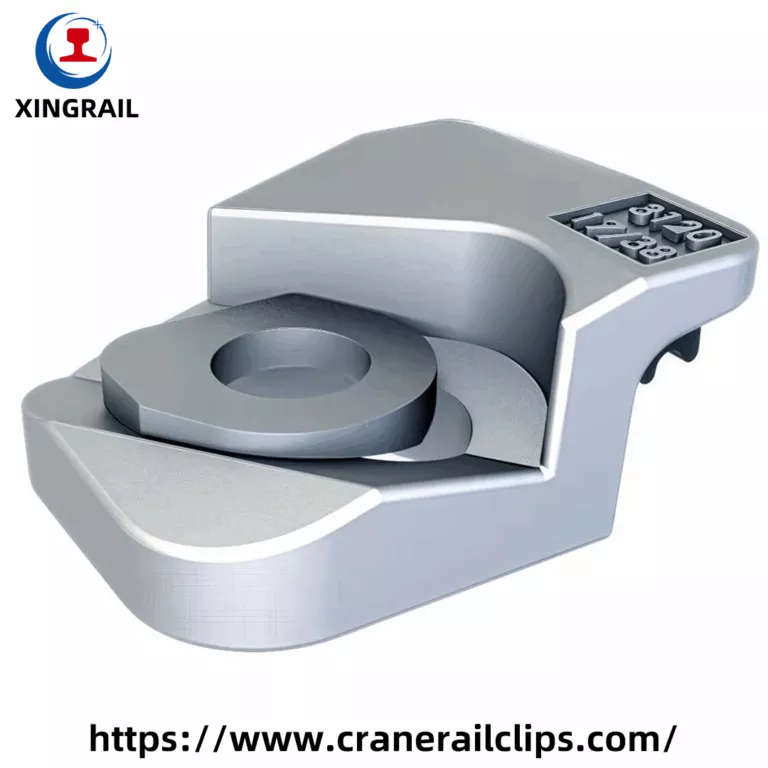
A crane rail fastening clips system is a highly engineered mechanical setup designed to anchor heavy runway tracks to structural steel beams or concrete foundations. These important systems typically consist of a weldable or bolt-on base, a forged upper clamping plate, a high-strength captive bolt, and a vulcanized rubber pad or nose.
The primary job of these industrial crane rail fastening clips is to clamp the track flange tightly while absorbing massive dynamic loads. They hold the rail down securely while simultaneously allowing for slight, necessary longitudinal movements caused by thermal expansion. Because they offer precise horizontal adjustments and lateral load resistance, a robust crane rail fastening clips system acts as the core foundation for any safe, high-capacity runway setup.

Common Challenges in Crane Rail Installation
Installing a runway system requires strict adherence to engineering tolerances. Crane installation contractors and facility engineers regularly face operational hurdles that threaten track integrity. Typical problems include:
- Rail Misalignment: Immense lateral forces slowly push tracks out of their straight gauge. This causes dangerous wheel wear and potential derailment.
- Vibration and Impact Loads: Moving multi-ton cargo sends massive shockwaves through the structure. Without dampening, these vibrations loosen or destroy rigid bolts.
- Structural Fatigue: Continuous dynamic loading weakens the track and the supporting steel beam over time.
- Rail Movement: Thermal expansion and heavy braking forces cause tracks to shift lengthwise along the beam.
- Maintenance Difficulties: Runway beams sit high above the factory floor.
A high-quality crane rail fastening clips system solves these issues directly. These systems use vulcanized rubber noses to dampen harsh vibrations safely. Furthermore, advanced rail clip fastening systems lock the track in place laterally while allowing safe thermal expansion, vastly reducing structural fatigue over time.
Welded vs Bolted Crane Rail Clips
When designing a runway, you must choose between welded and bolted fastening methods depending on your operational environment.
Welded crane rail clips feature a lower base plate that permanently welds directly to the steel runway girder. They offer maximum resistance to lateral forces and harsh vibration. Because the base is permanently fixed, weldable clips eliminate the need to drill holes into the structural beam, completely preserving its load-bearing integrity.
Bolted crane rail clips secure directly to concrete foundations, steel soleplates, or pre-drilled girders using heavy-duty anchor bolts. They are much easier to replace and install in facilities where welding poses a fire hazard. Bolt-on adjustable rail fastening systems are highly preferred for lighter load applications or setups where tracks might require frequent relocation.
Recommended XINGRAIL Crane Rail Clips
For premium performance, the XINGRAIL product series delivers unmatched reliability and safety. Below are highly recommended models for demanding industrial applications requiring a dependable crane rail fastening clips system.
|
Model |
Base Material |
Surface Treatment |
Lateral Force Resistance |
Horizontal Adjustment |
Applications |
Special Features |
|
Forged Steel |
Zinc Plated |
Up to 75 kN |
15 mm |
Light/Medium Cranes |
Low profile design |
|
|
Forged Steel |
Hot Dip Galvanized |
Up to 125 kN |
20 mm |
Heavy-Duty Cranes |
Double bolt fastening |
|
|
Cast/Forged Steel |
Anti-Corrosion Paint |
Up to 150 kN |
20 mm |
Ports & Shipyards |
High lateral resistance |
|
|
Forged Steel |
Zinc Plated |
Up to 100 kN |
15 mm |
Steel Mills |
Superior vibration dampening |
Crane duty rarely suits a railway elastic clip, so we compare Pandrol clip alternatives against our forged self-locking crane rail clamps in a dedicated cross-reference guide.
Compatible Crane Rails and Track Standards
Global infrastructure projects demand crane track fastening solutions that adapt to multiple international profiles. Quality fasteners ensure universal compatibility across borders and engineering standards.
You can easily configure these precision components to fit:
- DIN536 crane rails: The dominant standard used in European manufacturing and global port facilities.
- AREA crane rails: The standard profile for North American heavy-load systems.
- BS railway tracks: British standard profiles found in legacy and modern transit systems.
- China standard rails (QU series): Widely utilized in massive global infrastructure projects.
- Indian standard rails (CR series): The primary standard for South Asian heavy manufacturing.
- Other standards: GOST rails, SABS rails, and Australian standard rails.
By using an adjustable upper clamp, a versatile crane rail fastening clips system securely grips the varying flange widths and angles of these diverse international track profiles.
Typical Applications of Crane Rail Fastening Clips Systems
Heavy industries rely on seamless, uninterrupted equipment movement. You will find heavy-duty crane rail fastening solutions actively anchoring operations in several demanding sectors.
- Container Ports: Ship-to-shore cranes operate around the clock. They require fastening systems that handle corrosive coastal winds and extreme lifting loads.
- Shipyards: Massive hoists move heavy shipbuilding steel. Welded fasteners maintain perfect gauge despite heavily unbalanced loads.
- Steel Mills: High heat and abrasive metallic dust degrade standard bolts quickly. Forged components provide permanent security here.
- Automated Warehouses: Automated robotic systems demand absolute track precision to prevent system crashes and inventory damage.
- Mining Facilities: Heavy dropped materials cause massive impact shockwaves that only forged systems can safely absorb.
- Heavy Manufacturing Plants: Overhead lifting equipment moving large machinery relies on robust rail support and fastening systems to avoid dangerous production halts.
Installation Best Practices for Crane Rail Clips
Precise installation guarantees the safety of the entire runway system. Contractors should follow these exact procedures to install a crane rail fastening clips system properly:
At each end of the runway, crane runway buffer stops absorb the impact energy that fastening clips alone are not designed to handle.
- Welding Procedures: Clean the steel runway beam completely. Use appropriate low-hydrogen electrodes to weld the lower base component parallel to the track axis.
- Rail Alignment: Lay down the elastomeric pad and position the track. Use proper alignment tools to ensure the gauge follows engineering tolerances perfectly.
- Bolting Methods: Assemble the upper piece onto the welded base. Ensure the rubber nose sits completely flush against the track flange.
- Tightening Torque: Apply torque strictly matching the manufacturer’s data. Over-tightening crushes the rubber dampener, while under-tightening allows dangerous track movement.
- Inspection and Maintenance: Schedule regular checks to verify torque levels. Ensure the vulcanized rubber has not degraded from harsh weather or chemicals.
Why Forged Crane Rail Clips Improve Durability
Not all metal fasteners perform equally under severe industrial stress. Heavy-duty crane rail clips made from forged steel offer massive structural advantages over basic cast iron alternatives. The specific forging process aligns the internal grain structure of the steel.
For non-standard rail sections or unusual load cases, a custom crane rail clips manufacturer can forge a clip to your exact drawing and duty rating.
When high-capacity lifting equipment brakes suddenly, forged components distribute the harsh sheer forces safely into the supporting girder. Additionally, the high density of forged steel helps absorb mechanical vibrations. This translates directly to a much longer service life for both the fastener and the structural girder.
Heavy Duty Crane Rail Fastening Clips Systems for Gantry Cranes
Large gantry cranes and container handling equipment present difficult engineering challenges. They operate entirely outdoors, exposed to high winds, massive temperature swings, and severe load shifting. To operate safely, these massive structures require a highly specialized crane rail fastening clips system.
Welded fasteners support massive gantry systems by offering superior lateral force resistance. The adjustable upper plates allow maintenance crews to easily re-align the track horizontally as the ground settles over the years. This precise adjustment ensures the massive steel wheels never bind, scrape, or derail during critical port operations.
How to Install Crane Rail Fastening Clips Systems on Crane Runway Beams
Contractors executing track installations follow a strict, sequential process to ensure safety and alignment. Here is how you install a crane rail fastening clips system effectively:
- Surface Preparation: Grind away all rust, old paint, and dirt from the steel girder where the base will sit.
- Position the Base: Using chalk lines, place the weldable base parts at specified intervals along the girder.
- Weld the Base: Weld the base parallel to the track path using the specific fillet welds designated by the project engineer.
- Place the Rail: Carefully lower the track into position over the center of the continuous rubber pad.
- Attach Upper Clips: Slide the forged steel crane rail fastening clips over the track flange.
- Apply Torque: Insert the heavy-duty bolts and tighten them to the exact specified torque rating.
Best Crane Rail Fastening Clips Systems for DIN536 Crane Rails
The widely used DIN536 standard features a distinctly wide, flat bottom and a thick central web. Engineers designed this shape specifically to carry immense wheel loads. Common track sizes include A45, A55, A65, A75, A100, A120, and A150.
Because these tracks have unique sloping flanges, you must select a crane rail fastening clips system that matches that angle perfectly. High-capacity welded fasteners, such as the XINGRAIL 9220/20/45, feature specifically angled upper plates. These plates mate seamlessly with the broad base of DIN536 tracks, ensuring maximum surface contact.
FAQs
- What are crane rail fastening clips systems used for?
A crane rail fastening clips system securely attaches heavy tracks to structural girders. It prevents dangerous lateral movement, maintains exact track gauge, and absorbs severe mechanical vibrations generated by moving loads. - What is the difference between welded and bolted crane rail clips?
Welded fasteners feature a lower base that permanently welds to the steel support girder. Bolted fasteners secure directly into pre-drilled holes. - How strong are crane rail fastening clips systems?
Strength varies strictly by model and material. However, heavy-duty forged steel systems can withstand lateral forces ranging from 75 kN up to 300 kN per unit, easily handling the demands of massive container ports. - Are crane rail fastening clips systems suitable for DIN536 crane rails?
Yes. High-quality fasteners feature fully adjustable upper components engineered specifically to match the wide flanges of DIN536 tracks. They securely fit profiles from A45 up to A150. - How many crane rail clips are required per meter of rail?
While exact spacing always depends on an engineer’s specific load calculations, standard industrial installations typically require fasteners spaced every 500mm to 600mm along the beam.
Deep-Dive Technical Notes
ERTMS Standards Rail And Clip Requirements
How Physical Infrastructure Supports ETCS and GSM-R
While rails and clips are not “digital,” their performance is integral to the functioning of ERTMS. ETCS and Track Stability: The European Train Control System relies on data transmission between the track and the train. In ETCS Level 1, this is done via track-mounted transponders called Eurobalises. These balises must be positioned with millimeter precision. A track that shifts or settles due to a poor fastening system could move a balise out of alignment, causing a data transmission failure. The stability provided by high-quality rails and clips ensures that these critical components remain exactly where they need to be. GSM-R and Vibration: GSM-R provides the continuous radio link for ETCS Level 2 and Level 3. A smooth, well-maintained track with a resilient fastening system reduces vibrations on the train. Excessive vibration can damage sensitive onboard electronics, including the GSM-R radio and the ETCS computer, potentially leading to a system failure. The dampening properties of elastic clips help protect this vital equipment. The European Rail Traffic Management System represents the pinnacle of modern train control, but its success is built upon a foundation of steel and concrete. While ERTMS itself is a signaling and communication standard, it implicitly demands the highest quality from the physical infrastructure that supports it. For rails and clips, this means using heavy-duty, heat-treated rail profiles manufactured to exacting tolerances, and securing them with high-performance, fatigue-resistant elastic fastening systems. Only by ensuring the integrity and stability of the physical track can the full safety and performance benefits of a sophisticated system like ERTMS be realized.
Brazilian ABNT Rail And Clip Standards
Rail Steel Grades for Brazilian Heavy-Haul
The steel grades used are selected for maximum wear resistance and fatigue life to cope with the relentless traffic from mining operations. Grade Category Typical Hardness (HBW) Key Characteristics and Brazilian Application Standard Strength 248 (min) A basic carbon steel rail primarily used in yard tracks, sidings, and on lines with lower traffic density. It lacks the durability required for mainline heavy-haul service. High Strength (Premium) 341 – 388 This is the most common grade for Brazilian heavy-haul mainlines. These rails are heat-treated (either fully or just the head) to produce a hard, wear-resistant running surface capable of withstanding high axle loads and curving forces. Super Premium / Alloy 370 – 415+ Advanced alloy rails, often containing chromium, are deployed in the most punishing sections of track. This includes the sharpest curves and steepest gradients of iron ore lines, where they significantly reduce the rate of wear and extend rail life. Rails for Brazilian application undergo stringent quality control to ensure they can perform reliably in a tropical climate, which includes high humidity and heavy rainfall, making corrosion resistance and material integrity critical factors.
Common Fastening Systems Used in Brazil
For modern heavy-haul track built on concrete sleepers, elastic fastening systems are the universal standard. The Pandrol “e-Clip” and the more recent “FASTCLIP” systems are widely deployed due to their proven track record in the world’s most demanding heavy-haul environments.
For a detailed look at how the Pandrol-style W-shaped clip holds the rail and which components it pairs with, see our e clip rail fastening guide.
We keep a brand-by-brand Pandrol clip cross-reference so you can match an e-Clip or FASTCLIP replacement against our forged crane rail fastenings before ordering.
Table of Performance Requirements for a Brazilian Heavy-Haul Fastening System Parameter Typical Requirement Rationale in a Heavy-Haul Context Clamping Force > 18 kN per clip Provides the enormous restraining force needed to lock the rail in place against extreme dynamic and thermal forces. Toe Load ~1,850 kgf (approx. 18.1 kN) This is the direct force applied by the tip of the clip onto the rail foot, serving as a primary indicator of the system’s holding power. Longitudinal Restraint > 14 kN The total resistance of the fastening assembly against rail slippage. This high value is critical for the safety and stability of the track structure. Component Material High-strength spring steel (clips), ductile iron (shoulders), durable polymers (pads/insulators) Materials are selected for maximum strength, fatigue life, and resistance to environmental degradation, including UV exposure and humidity. Electrical Resistance > 10 kΩ Ensures reliable electrical insulation of the rails from the sleepers, which is essential for the correct operation of track signaling and train detection systems.
A Compresive Guide to Rail Clip Types from Xingrail
Comparison of Types of Rail Clips
It’s important to comprehend each rail clip’s unique features in order to select the best one. A thorough comparison of various rail clip types, such as E-type, SKL, Nabla, and crane rail clips , is given in the following table. The specifications draw attention to important variations in performance, application, and design. Feature E-Type Clip SKL Clip Nabla Clip Crane Rail Clip Primary Material Spring Steel (e.g., 60Si2MnA) Spring Steel (e.g., 38Si7, 60Si2CrA) Spring Steel Forged or Cast Steel Typical Clamping Force 8-12 kN 10-14 kN (Adjustable) 18-25 kN 25-200+ kN (Adjustable) Application Conventional ballasted tracks, wooden/concrete sleepers Ballasted and ballastless tracks, turnouts, high-speed lines Concrete sleepers, high-traffic lines Crane runways, industrial tracks, port facilities Fastening Method Driven into shoulder or held by anchor bolt Screw spike with angled guide plate Bolted to embedded sleeper anchors Bolted or welded to steel structure or concrete Key Advantage Simplicity, cost-effectiveness, easy installation Adjustable tension, high versatility High clamping force, excellent stability on concrete Extreme load capacity, lateral adjustability Associated Sleeper Concrete, Wood, Steel Primarily Concrete Exclusively Concrete Steel plates or concrete foundation System Complexity Low Medium Medium High Adjustment Limited (positional) High (tension) Limited High (vertical and lateral)
Std Gauge and Rail Clips
Maintenance Best Practices:
Regular Inspections: Track inspectors should regularly check for loose, broken, or corroded clips. A visual inspection can often identify potential issues. Toe Load Measurement: Periodically measure the toe load of the clips using specialized equipment to ensure they are still providing the required clamping force. Environmental factors and traffic can cause the force to degrade over time. Lubrication: For bolted systems, ensure that threads are properly lubricated to prevent corrosion and allow for easy adjustment or replacement. Component Replacement: Replace any clips, pads, or insulators that show signs of significant wear, corrosion, or fatigue. It is often recommended to replace all components of a fastening assembly at the same time to ensure system integrity. The synergy between a well-defined std gauge and a high-performance fastening system is the bedrock of modern railways. By selecting the appropriate rail profile and rail clips for the specific application and adhering to strict installation and maintenance protocols, railway operators can ensure a track infrastructure that is safe, durable, and capable of meeting the demands of today’s transportation needs.