Choosing the wrong crane rail steel grade leads to premature wear, unexpected downtime, and costly replacements. The crane rail steel grade defines what a rail is made of — its chemical composition, mechanical strength, and surface hardness — not its physical dimensions. Rail profile determines size; grade determines service life.
This guide compares all major rail steel grades, explains the key properties, and helps you match the right grade to your crane and application.

What Is a Crane Rail Steel Grade?
A crane rail steel grade is a standardized designation that specifies the steel’s chemical makeup and mechanical performance. Standards include DIN 536, GB 2585, AREMA, and EN 13674. Each standard defines acceptable ranges for carbon, manganese, silicon, and micro-alloying elements, along with minimum tensile strength, yield strength, elongation, and surface hardness.
Rail steel grades are independent of rail profile. You can have a QU80 profile in U71Mn or U75V grade. Profile fixes the cross-section; grade fixes how hard and tough that steel must be.
Crane Rail Profiles and Their Standard Grades
Different rail families pair with different grade conventions. See crane rail specifications and crane rail dimensions for full profile tables.
| Rail Family | Profiles | Typical Grades |
|---|---|---|
| DIN 536 A-series | A45–A150 | St 70-2, 900A |
| Chinese QU-series | QU70–QU120 | U71Mn, U75V |
| CR / AREMA | CR80, CR100 | AREMA Gr. A, HH |
| British BS | BS75A, BS90A | 880, 900A |

Crane Rail Steel Grade Chart
| Grade | Standard | C % | Mn % | UTS (MPa) | Hardness (BHN) | Delivery | Typical Use |
|---|---|---|---|---|---|---|---|
| U71Mn | GB 2585 | 0.65–0.77 | 1.10–1.45 | ≥880 | 260–300 | As-rolled | QU70/80, general EOT |
| U75V | GB 2585 | 0.71–0.80 | 0.75–1.05 | ≥980 | 280–320 | As-rolled / HH | QU100/120, heavy duty |
| St 70-2 | DIN 536 | 0.60–0.80 | 0.80–1.30 | ≥690 | 220–260 | As-rolled | A45–A100, light crane |
| 900A (1100) | EN 13674 | 0.65–0.82 | 0.80–1.30 | ≥1080 | 260–300 | As-rolled | A100–A150, heavy crane |
| 880 | BS 11 | 0.55–0.75 | 0.80–1.30 | ≥880 | 255–295 | As-rolled | BS75A–BS90A |
| AREMA Gr. A HH | AREMA | 0.67–0.80 | 0.70–1.00 | ≥965 | 321–363 | Head-hardened | CR80/CR100, port crane |
For DIN 536 rail grades and Chinese rail steel grades, see the linked standard pages. Use the rail weight calculator to confirm kg/m values by profile and grade.
Chemical Composition of Crane Rail Steel
Carbon is the primary hardness driver. At 0.65–0.75 % C, pearlitic microstructure forms naturally, giving the rail good wear resistance without brittle martensite. Manganese at 1.0–1.3 % refines grain and increases strength.
U71Mn uses aluminium deoxidation for a clean, fine-grained structure. U75V adds vanadium (0.04–0.12 %) for precipitation hardening, raising tensile strength above 980 MPa without significantly reducing toughness. UIC 900A uses a similar high-carbon approach but allows chromium additions for additional hardness retention in head-hardened (HH) versions.
Silicon (0.10–0.60 %) acts as a secondary deoxidiser and improves elastic modulus, useful under the point-contact load of crane wheels.

Hardness and Mechanical Properties
Crane rail hardness is measured at the rail head surface in Brinell Hardness Number (BHN). Higher BHN means better wear life but lower impact toughness, a critical tradeoff in cold-storage or low-temperature environments.
| Delivery State | Typical BHN | UTS (MPa) | Application |
|---|---|---|---|
| As-rolled | 220–280 | 690–880 | Light to medium EOT |
| Head-hardened (HH) | 300–370 | 980–1100 | Heavy-duty, port, ladle |
| Heat-treated (QT) | 340–390 | ≥1100 | Extreme wear, curved track |
Crane rail material properties differ from mainline rail because crane wheels generate point contact stress rather than distributed load. A minimum surface hardness of 250 BHN is recommended for wheeled overhead cranes above 20 t.

Which Grade Should You Choose?
Select the steel grade for crane rail based on three factors: wheel load, duty cycle, and operating environment.
- Light duty (≤10 t, low cycles): St 70-2 or 880, as-rolled
- Standard EOT (10–50 t): U71Mn or 900A, as-rolled
- Heavy duty (>50 t, high cycles): U75V or 900A HH, head-hardened
- Cold storage / low temperature: 880 or U71Mn with guaranteed Charpy impact at −40 °C
- Port / ladle crane: AREMA Gr. A HH or R350HT
Regional convention also matters. Chinese projects typically specify U71Mn with QU-series profiles. European projects use DIN A-series with St 70-2 or 900A. North American projects follow AREMA with CR or T profiles. Match your crane rail steel grade to the dominant regional standard to simplify procurement and certification.

Matching Rail Grade with the Right Rail Clip
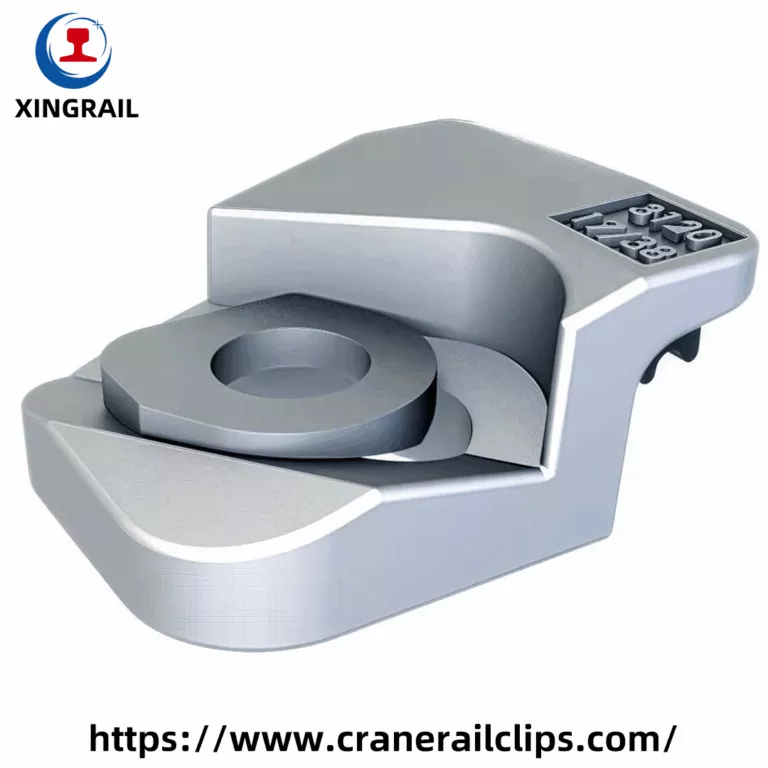
Rail grade hardness determines the clamping load your clips must handle. Harder rails require clips with higher spring force to avoid embedment under dynamic load.
| Rail Series | Clip Series | Clip Material | Hardness |
|---|---|---|---|
| QU70 / QU80 | FC-Q | 60Si2MnA | 44–48 HRC |
| DIN A45–A120 | FC-A | 38Si7 | 44–48 HRC |
| CR80 / CR100 | FC-CR | 60Si2MnA | 44–48 HRC |
Use the rail clip selector to match your profile and grade automatically. Full material and load data is at crane rail clip specifications.
Ordering, Inspection and Certificates
Every shipment of crane rails should include a Mill Test Certificate (MTC) to EN 10204 3.1, covering spectroscopic chemical composition, tensile test results, hardness readings per heat, and, for HH grades, hardness depth profile. Third-party inspection by SGS or BV is standard for large orders or projects with independent owner’s engineers.
Frequently Asked Questions
Q1: What steel is used for crane rails?
— Pearlitic carbon-manganese steel, typically 0.65–0.80 % C. Common grades are U71Mn (China), 900A (Europe), 880 (UK), and AREMA Gr. A (North America).
Q2: What is crane rail hardness in BHN?
— As-rolled rails: 220–280 BHN. Head-hardened rails: 300–370 BHN. Heavy-duty cranes should use rail with at least 260 BHN at the head surface.
Q3: What is the difference between U71Mn and U75V?
— U75V has higher carbon and vanadium, giving tensile strength above 980 MPa vs. 880 MPa for U71Mn. Use U75V for heavier loads and higher cycles.
Q4: Does DIN 536 specify a steel grade?
— DIN 536 specifies rail profiles (A45–A150), not steel grades. St 70-2 and 900A are the grades commonly paired with DIN 536 profiles.
Q5: Can I use railway track steel grade for a crane rail?
— Not recommended. Crane rail grade must tolerate point contact stress from crane wheels, requiring a harder and more consistent head surface than most mainline railway grades provide.
Need Help Selecting a Crane Rail Steel Grade?
Tell us your rail profile, wheel load, duty class, and operating environment. We will recommend the correct crane rail steel grade and matching clip series, and provide a competitive quote for both rails and fastening systems.