Crane rails carry loads that no railway track ever sees. A ship-to-shore gantry can push 60 to 90 tonnes through a single wheel. Every start, stop, and skew sends that force sideways into the rail foot. What holds the rail in place is a small forged part: the rail clamp. Get it right and the track stays true for twenty years. Get it wrong and you face rail creep, cracked grout, chewed-up wheels, and unplanned shutdowns.
Two families of clamps dominate industrial crane runways. Welded rail fixing clips and bolted rail fixing clips. Both do the same job. They do it in very different ways.
Table of Contents
ToggleWhat a Crane Rail Clamp Does
A crane rail clamp presses down on the rail foot and holds it against the supporting steel or concrete. Three forces act on it at once.
Vertical clamping force keeps the rail seated so it cannot lift under wheel passage.
Lateral restraint stops the rail from walking sideways when the crane skews or brakes.
Longitudinal grip resists creep caused by thermal movement and acceleration.
A good clamp does all three without locking the rail rigidly. Steel rails expand and contract. A 100-metre runway can move 30 mm or more between winter and summer. Clamps that fight this movement transfer stress into the beam and the welds. Clamps that allow controlled movement while keeping the rail on line last far longer.
Welded Rail Fixing Clips
Welded clips attach to the runway beam or sole plate by fillet weld. There is no drilling. The base sits on the steel surface, gets welded on both sides, and the clip body holds the rail foot.
Typical welded models include the 9216-08-40, 9120-15-38, 9116-08-3, and 7216-20-39 series. Numbers refer to clip height, adjustment range, and rail foot width coverage.
Where welded clips work best
- New steel runway beams where drilling would weaken the flange
- Port and shipyard tracks with very high wheel loads
- Sites where a permanent, tamper-proof fixing is wanted
- Continuous rail installations on embedded sole plates
Trade-offs to accept
Welding needs a qualified welder and clean, dry steel. Site conditions matter. Replacement means cutting and re-welding, which is slower than turning a nut. On galvanised or painted beams, the coating must be removed and restored afterwards.
Welded clips shine when the runway will not change. Once the geometry is set, the fixing stays put. Many operators choose welded crane rail clips for outdoor container terminals for this reason. Salt air and constant vibration are hard on bolted joints. A sound weld does not loosen.
Bolted Rail Fixing Clips
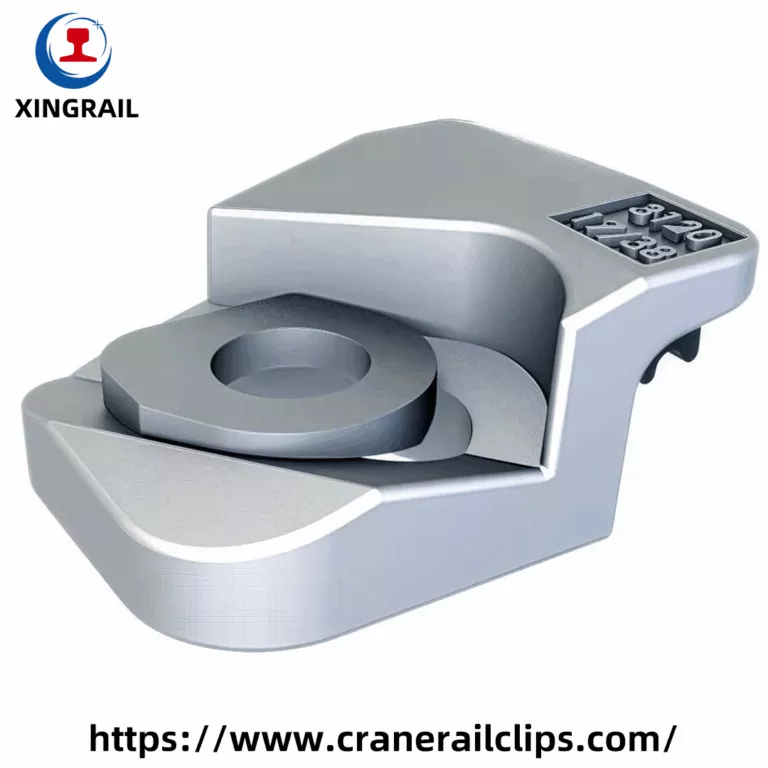
Bolted clips use an anchor bolt, a hex nut, and a spring washer or elastic element. The clip body sits over the rail foot and the bolt passes through a hole or slot in the beam, sole plate, or anchor rail.
Common bolted models include the 3120-17-38, 3220-17-38, 3222-17-44, and 3224-20-44 series. Many come with a serrated or eccentric base so the clip can shift laterally by 10 to 20 mm during alignment.
Where bolted clips work best
- Retrofit and rail replacement work
- Concrete foundations with cast-in anchor bolts or channels
- Runways that need periodic re-alignment
- Indoor overhead crane beams in workshops and mills
Trade-offs to accept
Bolts need torque checks. Heavy vibration can back off a nut over time, so lock nuts, spring washers, or thread locker are standard practice. Drilling the beam takes time and must follow the structural design.
The big advantage is adjustability. A bolted crane rail clip can correct gauge drift without touching the structure. On old runways where the beam has sagged or twisted, this saves weeks of work.
Related: polar crane rail fastening systems with weldable bases and bolted adjustable caps.
Welded vs Bolted at a Glance
|
Point |
Welded clips |
Bolted clips |
|
Fixing method |
Fillet weld to steel |
Anchor bolt and nut |
|
Lateral adjustment |
Fixed once welded |
10–20 mm typical |
|
Install speed |
Fast for a welder |
Fast where holes exist |
|
Removal |
Cut and grind |
Loosen the nut |
|
Best surface |
Steel beam or sole plate |
Steel or concrete |
|
Maintenance |
Visual weld checks |
Torque checks |
|
Vibration resistance |
Very high |
High with locking parts |
|
Suits new build |
Yes |
Yes |
|
Suits retrofit |
Limited |
Excellent |
Many projects use both. Welded clips on straight runs where alignment is settled. Bolted clips near rail joints, curves, and end stops where future adjustment is likely.
Related: crane rails specifications and rail clips installation.
How to Match Clamps to Your Rail Profile
Clamp selection starts with the rail, not the crane. Three numbers decide the answer.
Rail foot width.
A DIN A100 rail has a 200 mm base. A QU100 has 200 mm. A 60E1 railway rail has 150 mm. The clip must sit flat on the foot with correct overlap.
Rail foot thickness at the clamp point.
This sets the clip height. A clip that is too tall applies no pressure. Too short and it bears on the wrong face.
Rail weight and duty class.
Heavier rails under higher loads need larger clips and more clamping force per metre.
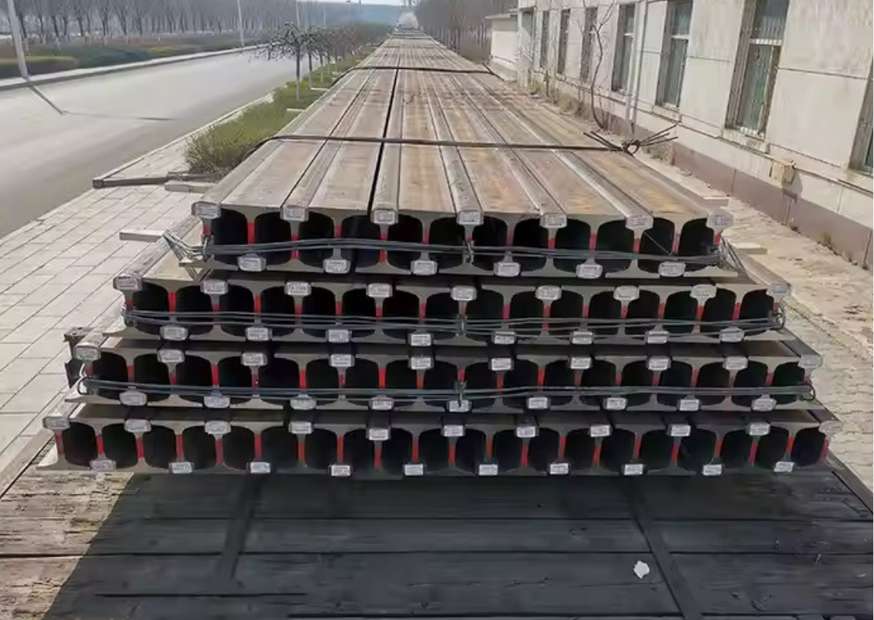
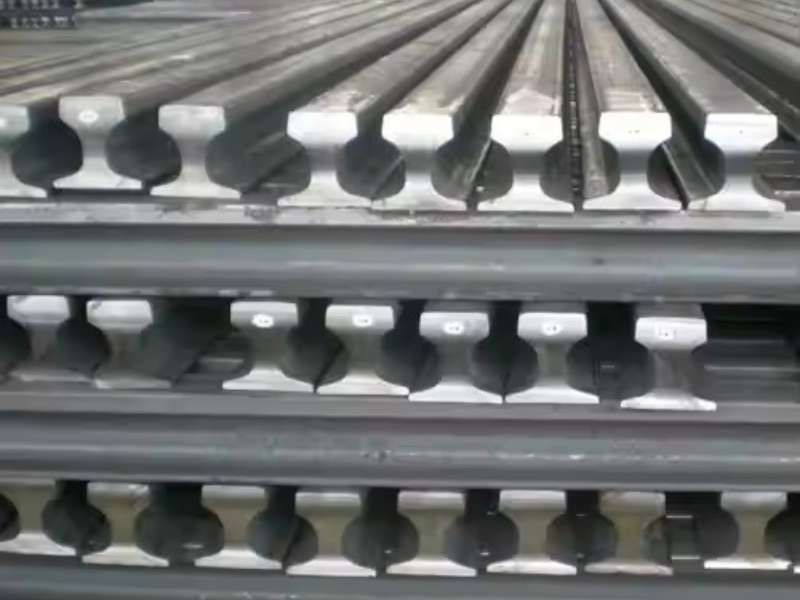
Crane rail profiles follow their own standards. DIN 536 covers A45 through A150. American practice uses ASCE and crane rail sections such as 104 lb and 175 lb. Chinese practice uses QU70, QU80, QU100, and QU120. Railway profiles like 50E1, 60E1, and 115RE also appear on gantry tracks where wheel loads are moderate. Full profile tables and mass figures are set out in the rail weight complete guide, which is worth checking before you order.
Chinese practice uses QU70, QU80, QU100, and QU120 — and within that family the QU80 runway is the workhorse of gantry and RMG installations. Our QU80 clip selection guide walks through welded versus bolted options for that profile.
If you are still fixing the profile, compare options against crane rail dimensions first. The clip follows the rail. Changing the rail after clips arrive is expensive.
Clamp Spacing and Order Quantity
Standard spacing on crane runways is 500 mm to 700 mm. Most projects settle on 600 mm. Clips install in pairs, one each side of the rail, at every position.
The arithmetic is simple.
Positions = track length ÷ spacing Clips = positions × 2 per rail
A 100-metre single rail at 600 mm spacing gives 167 positions and 334 clips. A twin-rail runway doubles that to 668 clips. Add 3 to 5 percent for spares.
Tighter spacing applies at three places. Within 300 mm of a rail joint. On curved sections. Near end stops and buffer zones. Some port specifications call for 400 mm spacing across the full length of an STS crane track.
Where the runway ends, a crane rail bumper absorbs the residual impact energy that tighter clip spacing cannot.
You can skip the hand calculation. Use the configurator below to pick a category, a rail model, and a track length, then get a clip recommendation with quantity.
The same tool is available as a standalone page: Smart Rail Clip Configurator.
Installation Points That Matter
Level the seat first.
Elastomeric pads under the rail need a flat, clean bearing surface. A 1 mm high spot creates a hard point that will hammer itself into a crack.
Set gauge before final tightening.
Check gauge every 3 metres with a proper gauge bar. Tolerance for gantry cranes is usually ±3 mm, tighter on automated systems.
Torque bolted clips in stages.
Snug all nuts first, check alignment, then torque to the specified value. Typical figures run 120 to 250 Nm depending on bolt size. Follow the drawing, not habit.
Weld in short runs.
Long continuous welds pull the beam. Alternate sides and let heat dissipate.
Leave rail joint gaps as designed.
Do not clamp hard against a fishplate joint. Thermal movement needs somewhere to go.
Mistakes That Cut Clamp Life Short
Over-tightening is the most common one. Crushing the elastic pad kills its resilience. The rail then transmits shock straight into the structure.
Mixed clip types on one runway cause uneven stiffness. The stiff sections take more load and fail first.
No pad at all is a false economy. A 6 mm to 10 mm elastomer pad spreads wheel load, cuts noise, and doubles rail life in heavy duty service.
Skipped inspections let small problems grow. A quarterly walk of the runway catches loose nuts and rail creep early. Compare what you find against the layout of a proper crane rail fastening system so you know what normal looks like.
Materials and Quality Checks
Serious crane rail clamps are forged, not cast. Forging aligns the grain and gives higher fatigue strength. Common grades are 45# steel, 40Cr, and Q345B for base plates. Hardness after heat treatment usually falls between HB 200 and HB 280.
Ask suppliers for four things. Material certificate. Dimensional report. Clamping force test data. Salt spray hours for the coating. Hot-dip galvanising at 60 to 85 microns suits coastal sites. Dacromet gives thinner coverage with good corrosion numbers.
Suzhou Xingrail Rail FastenTech Co., Ltd manufactures both welded and bolted clip families to DIN, AREMA, GB, and customer drawings, with samples available for fit checks before bulk production.
Quick Answers
Are welded clips stronger than bolted clips?
Not inherently. Both are designed to the same clamping force. Welded clips resist loosening better. Bolted clips allow adjustment.
Can I use railway rail clips on a crane runway?
Usually no. Railway clips suit sleepers and different foot geometry. Crane clamps handle concentrated wheel loads on steel beams.
What spacing should I use?
600 mm as a default. 400 to 500 mm for heavy port cranes and curves.
How many clips do I need per metre?
About 3.3 pieces per metre of single rail at 600 mm spacing, counting both sides.