The rail fastening system is important to railway infrastructure stability and safety. These systems, range from rail fastening components to cutting-edge rail fastening technology. This blog explores rail fastening systems and their usefulness in railway construction across various train systems. Learn how rail fastening solutions increase track performance, their materials, and their important function in modern rail track fastening systems.
For the 75 mm DIN 536 A-series head, see our A75 rail fastening guide for self-locking and forged clamp options.
For the 80 mm head series, see our CR80 rail clip selection guide for sizes and clamp options.
For the 100 mm head series, see our CR100 rail fastening guide for self-locking and forged clamp options.
For the 120 mm head series, see our CR120 crane rail clips guide for heavy-duty clamp options and full specifications.
When the rail is an 85 lb/yd ASCE section, ASCE 85 rail fastening follows the same elastic clip and forged clamp principles.
Heavy sections need a different fastener plan — the dedicated 60kg rail fastening guide sets out which assembly suits 60 kg/m rail.
For a deeper look at the subject, see heavy-duty rail fixing systems, industrial rail fixing solutions, crane rail stabilization clips, bolted crane rail anchoring systems and rail fixing systems for industrial cranes.
What Are the Components of a Rail Fastening System?
A rail fastening system secures rails to sleepers. Rail clamps secure the rail, and rail cushions prevent vibrations and wear on the sleeper. A sturdy foundation from anchor bolts and base plates distributes load uniformly over the track structure. These components strengthen the railway fastening system and improve track stability under large loads and high speeds.
To satisfy modern railway needs, rail fastening systems use improved materials and designs. For example, elastic rail clips absorb dynamic forces and high-quality rail pads reduce noise and vibration. Rail track fastening systems and rail fastening solutions are designed for high-speed railways and long-haul freight lines. The system optimizes performance, minimizes maintenance costs, and extends railway infrastructure lifespan by integrating these components.

When a line is specified around a branded system, sourcing a Pandrol-type rail fastening with matching hole pitch and clamping force is usually the fastest route to a second supply source.
How Does a Rail Fastening System Work in High-Speed Rail?
High-speed rail’s rail fastening system secures rails to sleepers. Elastic rail clamps secure the rails while allowing moderate flexibility to absorb vibrations and reduce track stress. Rail cushions between the rail and sleeper reduce noise and vibration. Base plates evenly distribute stress. These parts improve railway fastening system durability and safety.
High-speed rail requires sophisticated rail fastening technology to accommodate quicker trains’ forces. The system uses strong materials to withstand severe loads and temperature and moisture changes. Railway fastening solutions save maintenance and ensure long-term performance. Precision engineering keeps the rail track fastening system aligned. The system meets high-speed rail criteria by combining these components well.
What Are the Types of Rail Fastening Systems?
Rigid and elastic rail fastening systems exist. In rigid systems, bolts and clamps securely attach the rail to the sleeper. Railways with low speeds or light loads commonly use these simple systems. Their inability to absorb dynamic stresses restricts their effectiveness on current, high-speed railways. However, elastic fastening systems use elastic rail clips and pads to regulate rail movement. Flexibility reduces vibrations and evens load distribution.
By application, elastic fastening systems are further separated into distinct designs. Some systems meet high-speed rail requirements with modern rail fastening technology, while others are for heavy-haul freight lines. Quality rail fastening components like resilient rail pads and sturdy clips improve track stability and reduce maintenance in these systems. Speed, load, and environmental conditions determine whether rigid or elastic railway fastening systems are used. Engineers improve railway safety and efficiency by choosing the right rail track fastening system.
Branded elastic systems are the most common to replace, so we published a Pandrol-type elastic rail fastening cross-reference covering e-Clip and FASTCLIP equivalents.
How to Maintain a Rail Fastening System?
Regular inspections and timely repairs are required to maintain a rail fastening system. Engineers must inspect rail fastening components such as rail clips, rail pads, and anchor bolts for wear. You must quickly replace any component with considerable wear to prevent further degradation. Additionally, they should tighten loose bolts and secure rail fastening equipment. These stages stabilize the rail track fastening system and prevent misalignment.
Cleaning the rail fastening system removes debris, grime, and moisture that accelerate corrosion. Engineers should also coat or lubricate components to avoid rust and extend their lifespan. They must monitor high-speed railway systems’ performance and identify faults early with modern rail fastening technology. These maintenance procedures help railway operators improve safety, maintain the railway fastening system, and reduce downtime.
Xingrail offers stable, safe, and efficient rail fastening systems for various railway applications. Our innovative technologies and high-quality components ensure reliable performance under heavy loads and high speeds. We improve track durability and efficiency with regular maintenance and advanced solutions. You choose Xingrail for reliable rail fastening solutions that support your railway infrastructure’s long-term success. For optimal rail system performance, trust us.
Deep-Dive Technical Notes
STS Crane Rail Fastening Solution
Heavy-Duty 9 Series Welded Rail Clips Recommend
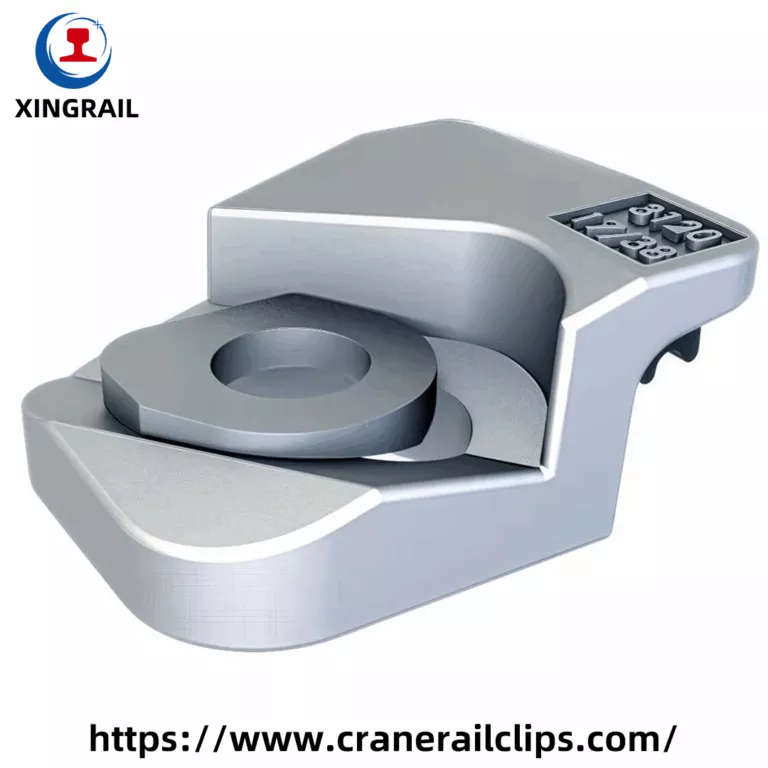
XINGRAIL 9220/20/45 : A high-capacity forged clamp designed for extreme lateral resistance during rapid crane braking. 9220 Technical PDF 9220 Welded Crane Rail Forged Fastening Clamp XINGRAIL 92202045 9220 Installation Instructions: Weld the clip base on all sides, except for the side closest and parallel to the rail, using a 5mm throat thickness fillet weld. Use low-hydrogen electrodes such as AWS E7018 or E7028 for the best results. The clip base is made from weldable-grade steel, ensuring a secure and durable installation. If a continuous weld around the clip base is required, this can be accommodated—please reach out to XINGRAIL for specific guidance. Tightening Torque: 350 Nm For detailed installation instructions or additional support, feel free to contact XINGRAIL directly. XINGRAIL 9216/08/40 : Ideal for medium-to-heavy tracks, offering a secure, maintenance-free welded base. XINGRAIL 9120/15/38 : Provides critical lateral adjustment after welding to ensure perfect rail alignment. XINGRAIL 9116/08/38 : A compact solution for precise positioning in high-frequency duty cycles. Model Base Material Surface Treatment Lateral Force Resistance Horizontal Adjustment Applications Special Features XINGRAIL 9220/20/45 Q355 Steel (ASTM A572 Grade 50, ISO S355) / Q235 Steel (ASTM A36, ISO S235) Galvanized 235 kN (24 tons) 20 mm Ports, terminals, gantry cranes, mining equipment Vulcanized rubber tongue for vibration damping, no need for steel beam holes XINGRAIL 9216/08/40 Q355 Steel (ASTM A572 Grade 50, ISO S355) / Q235 Steel (ASTM A36, ISO S235) Galvanized 130 kN (13.3 tons) 8 mm Ports, shipyards, automated storage cranes, mining equipment Simplified installation, supports various heavy rail models XINGRAIL 9120/15/38 Q355 Steel (ASTM A572 Grade 50, ISO S355) / Q235 Steel (ASTM A36, ISO S235) Galvanized 120 kN (12.2 tons) 15 mm Ports, shipyards, gantry cranes, mining equipment Noise reduction, vibration damping, direct welding to foundation XINGRAIL 9116/08/3 Q355 Steel (ASTM A572 Grade 50, ISO S355) / Q235 Steel (ASTM A36, ISO S235) Galvanized 55 kN 8 mm Ports, shipyards, automated storage cranes, mining equipment Compact design, suitable for narrow steel beams, noise reduction Key Features Across All Models: Material : Forged Q355 or Q235 steel, with international equivalents provided for clarity: Q355 : ASTM A572 Grade 50, ISO S355 Q235 : ASTM A36, ISO S235 Surface Treatment : Galvanized for durability in harsh outdoor environments. Installation : Welded base for stability, no need for pre-drilled holes in steel beams. Vibration Damping : Vulcanized rubber tongue reduces noise and absorbs vibrations. Applications : Designed for heavy-duty environments like ports, terminals, and mining.
Forged Steel Fastening Devices for Crane Rails and Heavy Track Systems
What Forged Actually Means Here
Forging starts with a solid steel billet. The billet is heated to roughly 1100–1250 °C, then pressed into a closed die under a hammer or hydraulic press. The metal flows into the cavity and takes the shape of the clip body. The important part is what happens inside the metal. Forging does not cut the grain structure. It bends it, so the grain flow follows the outline of the finished part. Around the nose, the bolt hole and the shoulder — the three places where stress concentrates — the fibres run parallel to the load path rather than across it. A cast part has no directional grain. It solidifies from liquid, which leaves shrinkage porosity, gas pockets and coarse dendrites. A machined-from-plate part has grain that runs in one direction only, so it is strong along the plate and weak across it. That difference shows up in fatigue life. Under repeated wheel passes, a cast clamp starts a crack at a subsurface pore. A forged steel crane rail clip has no such starting point. The same shape, the same weight, but several times the number of cycles before failure. crane rail clips bg image
Installation Points That Decide Service Life
Most failures traced back to installation, not to the part itself. Alignment first. Survey the rail before anything is welded or torqued. Gauge tolerance for gantry runways is commonly ±3 mm, with straightness held within 1 mm over any 2 metre length. Weld properly. Preheat to 100–150 °C on thick beam flanges. Use low-hydrogen electrodes such as E7018. Weld both sides of the clip base. Skip welds crack. Torque to spec, then check again. A typical M24 grade 8.8 bolt in this application takes 550–650 Nm. Retorque after the first 200 operating hours. The pad settles, and clamping force drops. Leave the pad room to breathe. The clip should hold the rail firmly without crushing the elastic pad flat. Over-clamping kills the pad’s damping function in months. Inspect on a schedule. Every six months, walk the runway. Look for shiny witness marks under the clip nose, loose nuts, cracked welds and pad extrusion. Any of these mean the rail has been moving.
Fastening Solutions for DIN A100 and DIN A120 Crane Rails
Top Recommended Clips for A100 & A120 Rails
To safely secure these heavy-duty profiles, we recommend our premium forged steel clips featuring a 20mm lateral adjustment range. This specific adjustment capacity perfectly accommodates the wide base widths of both the A100 and A120 rails, allowing engineers to standardize their hardware procurement across multiple projects. 1. Xingrail 9220/20/45 (Weldable Base) Max Lateral Force Resistance: 300 kN Best For: Steel mills, STS cranes, and environments requiring maximum shear resistance. Why it fits: The weldable base is permanently affixed to the steel support, while the upper forged clip utilizes a wedge-action self-locking mechanism. The 20mm adjustment absorbs structural settlement, and the heavy-duty vulcanized rubber nose protects the DIN rail’s wide flange from high-frequency shock. 2. Xingrail 3224/20/44 (Bolted / Perforation Type) Max Lateral Force Resistance: 150 kN Best For: Concrete runway beams (via soleplates) or steel girders where hot-work/welding is strictly prohibited. Why it fits: It utilizes M20 high-strength bolts (Grade 8.8 or 10.9) to provide a massive clamping force of 350 Nm. The 20mm horizontal adjustment stroke makes precision track alignment during installation highly efficient for both A100 and A120 profiles.
Crane Rail Fasteners and Bolts
Welded Clips and Bolted Clips
There are two families of crane rail fasteners, split by how the base attaches to the structure. Welded clips are fillet-welded directly to a steel runway beam or a steel sole plate. They suit indoor overhead crane runways, steel mill bays, and shipyard gantries where the supporting structure is already steel. Installation is fast. There is no drilling. The trade-off is that adjustment after welding is limited to whatever the clip’s own eccentric or serrated face allows. Common series include the 9000 and 7000 types, with clamping heights matched to rail foot thickness. You can compare profiles on the welded crane rail clips page. Bolted clips anchor into concrete through embedded anchor bolts, or bolt through a steel plate. Ports, container yards, and outdoor gantry runways nearly always use them. They can be loosened, shifted, and retightened during rail alignment or replacement. Many models offer 10 mm to 15 mm of lateral adjustment through an eccentric washer or slotted base. The bolted crane rail clips range covers the 3000 and 3200 series used for this work. A quick comparison: Feature Welded clips Bolted clips Base structure Steel beam or sole plate Concrete or steel Lateral adjustment Limited 10–15 mm typical Installation speed Fast Slower, needs anchors Replacement Cut and re-weld Unbolt Best use Indoor runways, mills Ports, outdoor gantries
When 115RE serves as a crane runway girder, 115RE crane rail clips should be forged or self-locking to resist lateral acceleration and braking forces.
Where OEM parts are cost-prohibitive, vossloh compatible rail clips match the original bar diameter, hardness, and toe force.
Bolts, Grades, and Torque
The bolt is where most fastening failures start. Choosing the clip and ignoring the bolt is a common mistake. Crane rail clips normally use M20, M22, or M24 hex bolts. Grade 8.8 is the working minimum. Grade 10.9 is standard for port cranes, steel mills, and any runway with high wheel loads or heavy travel frequency. Hot-dip galvanised or Dacromet-coated bolts are used in coastal and marine air. Approximate tightening values for dry, clean threads: Bolt size Grade 8.8 Grade 10.9 M20 390–420 Nm 550–580 Nm M22 530–570 Nm 750–790 Nm M24 670–720 Nm 950–1000 Nm Always confirm final torque against the clip manufacturer’s data sheet. Over-torque crushes the rail pad and destroys the elastic reserve that keeps the clip working. Under-torque lets the nut back off within weeks. Use a spring washer or a locking nut on every position. Vibration from crane travel loosens plain nuts faster than most people expect. On busy port runways, a torque check at 3 months and then annually is a sensible routine.
Railway Fasteners From Xingrail
Rail Spikes
Spikes are used almost exclusively with timber sleepers. They hold the rail and tie plate in place through friction and the mechanical strength of the wood fibers. Cut Spikes: The traditional railroad spike. They have a square shank and are driven into pre-bored holes in the sleeper. They provide good holding power but can loosen over time with the natural movement and degradation of the wood. Screw Spikes: These are essentially heavy-duty screws that are turned into the sleeper. They provide significantly higher holding power and resistance to pull-out compared to cut spikes. They are the standard for modern, high-performance track on timber sleepers and are also used in concrete sleeper systems with plastic dowels. Screw Spike Specifications for Concrete Sleepers Parameter Typical Specification Purpose Diameter 22 – 24 mm Provides the necessary shear strength and grip within the dowel. Length 150 – 180 mm Ensures deep engagement within the sleeper for maximum anchoring strength. Material Medium Carbon Steel (Quenched & Tempered) Offers a combination of high tensile strength and toughness to resist fracture.